

Executive Summary
India stands at a defining moment in its trade ecosystem transformation. While the country has successfully established itself as a global voice for trade digitalization, championing the G20 High-Level Principles on Digitalization of Trade Documents in 2023, the ground reality for Indian exporters remains a complex hybrid of advanced digital portals and persistent paper trails.
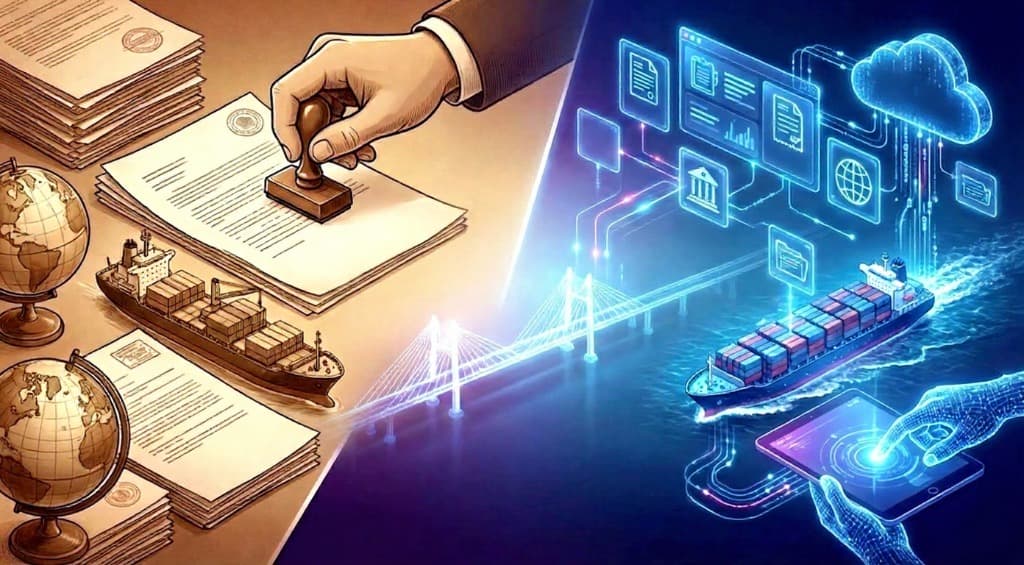
For the Indian MSME sector, which contributes nearly 45% of the country's exports, this duality presents both a challenge and an urgent opportunity. While customs clearance has become remarkably swift through ICEGATE, the critical ownership documents that facilitate payment and cargo release, such as Bills of Lading, largely remain physical. This digital island effect creates a disconnect where data moves instantly, but the legal documents lagging behind can stall shipments for days.
What You'll Learn
- What India's digitization gap is: advanced customs (ICEGATE) but paper-based Bills of Lading
- What Tata Steel's 2025 e-BL transaction reveals and what barriers prevent wider adoption
- How to take practical steps now to save 15-20% in trade costs before MLETR is enacted
The Current Situation: A Story of Two Speeds
To understand the landscape of digital trade documents in India, we need to look at the sharp contrast between government-mandated processes and commercial trade documentation. The ecosystem is currently operating at two very different speeds.
What Is Already Digital?
India's success story lies in its regulatory and compliance infrastructure. The adoption in these areas is near-universal, driven by government mandates and efficient platform design.
- Customs Declarations: The ICEGATE (Indian Customs EDI Gateway) system has achieved over 95% digitization for Shipping Bills and Bills of Entry. Physical filing is now the rare exception rather than the rule.
- Export/Import Licensing: The DGFT (Directorate General of Foreign Trade) portal has transformed license applications (like Advance Authorization or EPCG) into a faceless, paperless process.
- Certificates of Origin (Partial): Preferential Certificates of Origin for FTAs are increasingly being issued electronically through the CoO e-Platform, though physical copies are often still requested by partner countries.
What Remains Paper-Based?
The friction points lie in transferable documents, which represent title to goods or financial undertakings.
- Bills of Lading (B/L): This is the holy grail of trade digitalization. Globally, less than 5% of Bills of Lading are electronic. In India, despite successful pilots, the vast majority of transactions still rely on courier-delivered physical paper sets because they are negotiable instruments representing cargo ownership.
- Letters of Credit (LC): While banks have digital portals for application, the actual examination of documents under an LC is often a manual process involving physical papers, primarily because the underlying B/L is physical.
- Commercial Invoices: While created digitally, these are frequently printed, signed, stamped, and physically attached to shipments to satisfy various checkpoints that may not be digitally integrated.
The gap isn't technical, it's legal. Digital platforms exist for almost every trade document, but without legislation like MLETR, an electronic Bill of Lading doesn't yet have the same unquestioned legal standing as a paper one in Indian courts.
India's Policy Framework
India hasn't just been a passive adopter of digital trends. It has actively shaped the global narrative, particularly during its G20 presidency.
G20 High-Level Principles (2023)
In August 2023, under India's presidency, the G20 Trade and Investment Ministers meeting in Jaipur adopted the High-Level Principles on Digitalization of Trade Documents. These 10 principles laid the global groundwork for a transition that is neutral, secure, and interoperable.
Key principles championed by India included:
- Neutrality: Systems should be technology-agnostic, not favoring one blockchain or vendor.
- Interoperability: Different digital standards like UN/CEFACT must talk to each other.
- Data Privacy: Ensuring trade data is secure and sovereign.
This diplomatic win positioned India as a thought leader, signaling to the world that India is ready for paperless trade.
Foreign Trade Policy 2023-28
The FTP 2023 dedicated Chapter 9 specifically to "Promoting Cross Border Trade in Digital Economy." It laid out the roadmap for:
- Electronic execution of export/import documents.
- Integrating Indian systems with global platforms.
- Developing a "Trade Connect" e-platform to handhold MSMEs.
Digital Infrastructure Pillars
India has built a robust "India Stack" for trade:
- ICEGATE: The central nervous system for customs and cargo data.
- e-Sanchit: A repository that allows traders to upload supporting documents digitally once and use them across multiple transactions.
- ULIP (Unified Logistics Interface Platform): Integrates 30+ logistics systems to provide real-time visibility.
Case Study: Tata Steel's Paperless Leap (July 2025)
While policy sets the direction, industry executes the reality. A landmark transaction in July 2025 demonstrated that fully digital trade is not a distant dream but a present capability.
The Transaction Tata Steel executed India's first fully paperless coal import transaction involving a Letter of Credit (LC) and an electronic Bill of Lading (e-BL).
- Route: Coal shipment from Queensland, Australia to Dhamra Port, Odisha.
- Parties Involved: Tata Steel (Importer), Mining Company (Exporter), ICICI Bank (Issuing Bank), Standard Chartered (Advising Bank).
- Technology: The transaction utilized a third-party e-BL platform (ICE Digital Trade) integrated with the banks' systems.
Why It Matters Typically, importing bulk commodities involves a document race. The ship might arrive at the port in 15 days, but the documents (sent via courier from Australia to Singapore to India) might take 20 days. This forces importers to issue expensive bank guarantees to release cargo.
In this case, the transfer of title happened in minutes, not weeks. The e-BL was transferred digitally from the exporter to their bank, then to the Indian bank, and finally to Tata Steel.
The MSME Takeaway: If Tata Steel can do this for a massive coal shipment, the technology is proven. The same platforms used by giants are accessible to smaller players. The hurdle is no longer Will it work? but Will my bank and buyer agree to it?
Barriers to Adoption
If the technology works and policy supports it, why are we still printing millions of pages? The resistance comes from four consolidated barriers.
1. The Legal Gap (MLETR)
The most significant structural barrier is that India has not yet adopted the UNCITRAL Model Law on Electronic Transferable Records (MLETR).
- The IT Act, 2000 recognizes digital signatures and contracts but has specific exclusions for negotiable instruments (like Bills of Exchange) and documents of title.
- Without MLETR, an e-BL works only as a contractual solution (valid because all parties signed a user agreement), not a statutory one (valid by national law). This creates legal uncertainty for banks.
2. Infrastructure Gaps
While ports and metros are connected, the last mile of trade often originates in Tier-2/3 industrial clusters (e.g., Tirupur, Ludhiana, Moradabad).
- Reliable high-speed internet is essential for cloud-based trade platforms.
- Power outages can disrupt the real-time upload of critical documents.
3. The Cost of Being Digital
For a large corporate, a ₹50,000 annual subscription to a trade platform is negligible. For a micro-exporter, the costs add up:
- Direct Costs include subscriptions, Digital Signature Certificates (DSC), and software fees.
- Indirect Costs include training staff and upgrading hardware.
- Transition Costs mean running parallel systems (paper + digital) during the changeover doubles the workload initially.
4. Trust and Cultural Inertia
Trade is an old profession built on tangible trust. A stamped, signed paper feels real to a traditional clearing agent or banker in a way that a PDF or blockchain hash does not.
Common concerns include:
- What if the server crashes?
- What if the file gets hacked?
- Will the customs officer ask for the original?
These fears lead to a print everything anyway mentality, negating the efficiency gains.
The biggest productivity killer is the Hybrid Trap, where you create documents digitally but then print, sign, scan, and email them. This captures the worst of both worlds with the cost of technology and the slowness of manual processing.
Impact Analysis: The Economics of Digitalization
For Indian businesses, the shift to digital is not about being modern. It's about protecting margins.
Time Reduction
The traditional cycle takes 10-18 days. This includes 2 days for prep, 5-10 days for courier delivery, and 3-5 days for bank/customs processing.
The digital cycle takes just 2-3 days. You spend 1 day on prep, transfer happens instantly, and processing takes 1-2 days.
The impact is clear: Faster turnaround means capital is locked up for less time. For an exporter working on 90-day credit cycles, shaving off 10 days is a significant working capital benefit.
Cost Savings
Research by the Commonwealth and various trade bodies suggests digital trade can reduce transaction costs by 15-20%.
Eliminated costs include courier fees (₹2,000-₹5,000 per set), printing costs, and document storage/archiving fees.
Reduced costs include demurrage and detention charges. When documents arrive before the cargo, goods don't sit at the port waiting for clearance.
Supply Chain Resilience
The COVID-19 pandemic was a harsh lesson. When flights stopped, couriers stopped, and trade ground to a halt because physical papers couldn't move. Digital trade is crisis-proof. A digital file moves just as fast during a pandemic, war, or natural disaster as it does in normal times.
Recommendations for MSMEs
You don't need to wait for the government to pass MLETR to start saving money. Here is a phased approach to digitalization.
Phase 1: The Essentials (Immediate)
Start with ICEGATE. Ensure you (or your CHA) are using all available features of ICEGATE, not just basic filing. Use e-Sanchit for document storage.
Get a Class 3 DSC. This is your digital identity. Don't share the password; treat it like your bank PIN.
Use Digital Invoicing. Use accounting software (Tally, Zoho, etc.) to generate commercial invoices that can be directly exported to PDF/XML, rather than typing them out in Word.
Phase 2: Ecosystem Integration (3-6 Months)
Leverage Bank Portals. Stop visiting the branch for every LC application. Push your bank to enable their corporate internet banking for trade finance.
Register on the e-CO Platform. The DGFT's Common Digital Platform for Certificates of Origin saves time and courier costs for FTA exports.
Phase 3: Advanced Adoption (12+ Months)
Explore e-BLs. If you have repeat buyers and a forward-looking logistics partner, propose a pilot shipment using an electronic Bill of Lading.
Consider API Integration. If you are a mid-sized exporter, look at integrating your ERP directly with logistics providers to automate data flow.
Start with your Buyer: If your buyer in the US or Europe is already digital-savvy, ask them which platform they prefer. Adoption is often driven by the customer. Being able to accept digital documents is a powerful selling point.
Future Outlook
The trajectory is clear. The optional nature of digital documentation will disappear over the next 3-5 years.
- MLETR Adoption is Inevitable: India is actively studying the model law. Once adopted, the floodgates for digital trade finance will open.
- Global Standards: The EU and UK (with its Electronic Trade Documents Act 2023) are setting standards. Indian exporters to these regions will be forced to comply.
- Data-Driven Finance: Banks will move from document-based lending to data-based lending. They will lend against the data visibility of your shipment in real-time, rather than the physical paper possession.
Conclusion
India has established strong digital infrastructure and clear policy frameworks. The missing pieces are MLETR legislation and widespread business adoption.
For MSMEs, the risk lies not in digitizing, but in waiting. The efficiency gap between a digital-first exporter and a paper-based one is widening every month. By the time digital documentation becomes mandatory, the early adopters will have already optimized their supply chains, reduced their costs, and secured their place in the global market.
- Verify your AD Code registration on ICEGATE.
- Register on the CoO (Certificate of Origin) e-Platform.
- Ask your freight forwarder about their digital document capabilities.
- Digitize your record-keeping: Replace physical files with cloud storage.
Related Articles
- China Plus One India: Export Opportunity for MSMEs - How Indian MSMEs can win global export orders