
Quick Summary
Global buyers are actively diversifying supply chains beyond China, creating export opportunities for Indian MSMEs in electronics, textiles, chemicals, and auto-parts. This article covers what buyers evaluate beyond price, winning sectors, and a practical roadmap to become export-ready.
The Opportunity
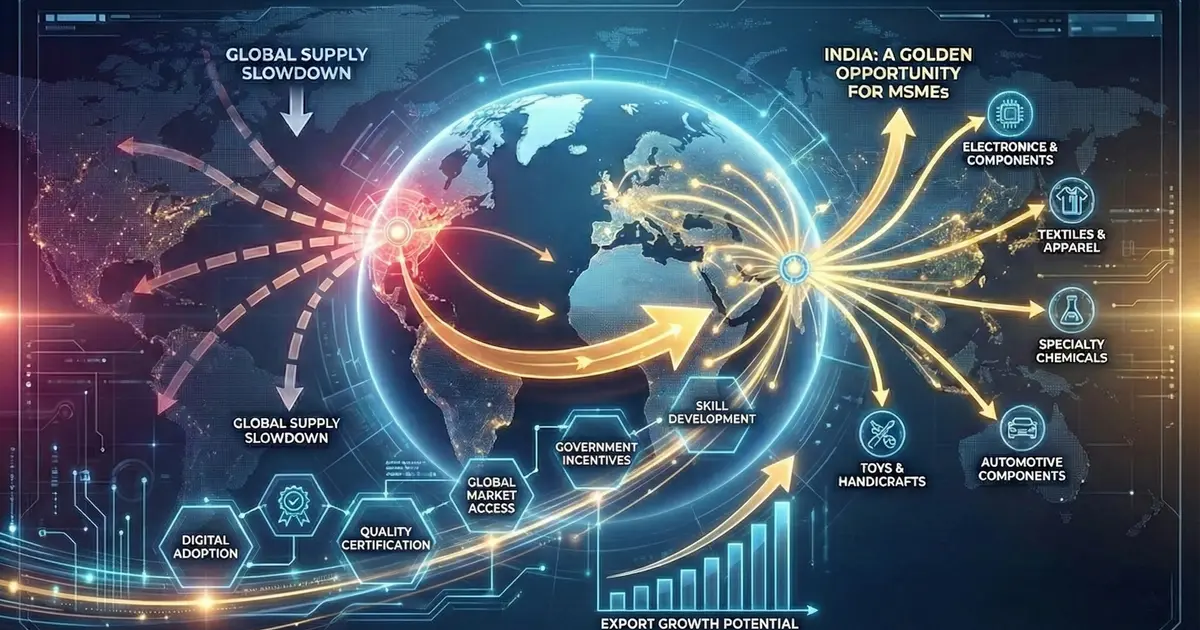
China plus one India is no longer just boardroom jargon. Global buyers are actively reducing single-country risk and building alternate supply bases for components, textiles, chemicals, and engineered parts, and Indian MSMEs can win these orders if they show consistency, compliance, and capacity.
What You'll Learn
- Why global buyers are diversifying and what makes Indian MSMEs competitive beyond price
- How to build an export-ready proof pack with quality documentation that speeds up buyer approvals
- What high-opportunity sectors exist and which specific capabilities buyers evaluate during selection
What “China Plus One” Means
For decades, many global supply chains were optimized around China as the default sourcing hub. The “China Plus One” approach means buyers keep China in the mix, but add at least one more country to reduce risk from disruptions, geopolitics, compliance changes, or shipping shocks.
For Indian MSMEs, this creates a window where credible suppliers can replace or complement Chinese vendors, especially in categories where India already has manufacturing depth.
Where the Demand Is Moving (Sectors Indian MSMEs Can Win)
The opportunity is broad, but buyers typically start with categories that are easy to qualify, have multiple SKUs, and need long-term supply stability.
| Sector | Why buyers are diversifying | What they ask from suppliers | What an MSME can do now |
|---|---|---|---|
| Electronics & components | Alternate sourcing for assemblies, cables, enclosures, and sub-parts | QC documentation, material specs, traceability | Standardize BOMs, create inspection reports, adopt process controls |
| Textiles & apparel | Risk diversification + compliance demands | Fabric specs, compliance certificates, sampling discipline | Build spec sheets, invest in finishing consistency, improve packaging |
| Specialty chemicals | Concentration risk and regulatory unpredictability | Safety data sheets, consistent batches, compliance | Formalize SDS/MSDS, batch testing, and buyer documentation |
| Auto components | Multi-sourcing for castings, fasteners, precision parts | PPAP-style evidence (in many cases), tolerance control | Create control plans, gauge calibration records, and traceable QC |
| Toys & handicrafts | Buyers seek diversified supply + differentiated designs | Safety/compliance, quality consistency | Ensure standards compliance and professional product photography |
Win on repeatability: global buyers don’t want a great first shipment. They want the 10th shipment to match the 1st in quality, documentation, and delivery.
What Global Buyers Evaluate
If you want to be shortlisted, your quote is only one part of the decision. Buyers usually evaluate:
- Quality system maturity: documented checks, inspection reports, calibration, defect handling
- Compliance readiness: correct product classification, required registrations, standards (where applicable)
- Capacity and lead times: realistic production capacity and stable delivery timelines
- Communication: professional responses, clear specs, and fast sampling cycles
- Packaging and labeling: export-grade packaging that reduces transit damage and returns
How to Capitalize: A Practical Roadmap for MSMEs
Step 1: Get your export basics in place
At minimum, buyers expect you to be ready for formal export documentation and compliance.
- You can explain your product HS code category and key specifications in one page.
- Your MSME profile is ready (including Udyam, if applicable) and your business details are consistent across documents.
- You have a basic quality workflow: incoming checks, in-process checks, and final inspection.
- You can share sample timelines, MOQ ranges, and a realistic lead time without overpromising.
- You have export-grade packaging standards (labels, cartons, inner protection) documented.
Step 2: Prepare a buyer-ready “proof pack”
Most MSMEs lose momentum because they respond with generic messages and no evidence. Create a simple pack (PDF or shared folder) with:
- Product catalog + spec sheets (dimensions, materials, tolerances where relevant)
- QC evidence (inspection checklist, sample inspection report, test results if applicable)
- Production capability (machines, monthly capacity, shift model, subcontracting policy)
- Compliance documents (as applicable) and packaging specs
Step 3: Nail sampling and first-article approval
Sampling is where trust is built. Treat samples like production:
- Send finished, export-ready samples (not “rough” units)
- Document variations and tolerances before shipment
- Include a short QC note: what was checked and what the results were
An auto-component MSME bidding for a casting order can share a one-page control plan, inspection report (critical dimensions), and calibration status for gauges. This reduces buyer risk and speeds up approval cycles.
Step 4: De-risk logistics and payments
For many first-time buyers, the biggest fear is “will this ship on time and will the paperwork be correct?”
Do the basics well:
- Quote with clear assumptions (lead time, MOQ, packaging, inspection scope)
- Clarify payment terms early (advance/LC/DP/DA depending on relationship)
- Use export credit protection tools where suitable (for example, explore ECGC coverage)
Step 5: Use ecosystems that increase credibility
Buyer trust grows faster when you’re visible in the right networks:
- Join relevant Export Promotion Councils (EPCs) for your sector
- Attend buyer-seller meets and trade fairs (even as a visitor first)
- Build a consistent digital presence with updated capability and product pages
- List on B2B marketplaces where buyers can filter by verification status, not just by keyword
That last point is the step most MSMEs skip. Being export-ready does nothing if the buyer diversifying away from China never finds you. A sourcing manager screening new suppliers wants to confirm you are a real, registered business before the first call, so a listing that already carries a verified GST and business registration clears their first filter for you.
Tradoi, our parent company (Trade in Bharat is its knowledge arm), is verified by default. A business cannot register or make its products public until it clears multi-layer verification, so a buyer browsing there knows every supplier has already cleared that floor. Verification is the price of being on the platform, not a badge some sellers buy and others skip. Tradoi handles no payments and no shipping, so it gets you found and checked, not paid. Whichever platform you choose, treat the listing as the start of the conversation and keep your proof pack ready.
Risks and Considerations
Most “China Plus One” orders are lost due to execution issues: inconsistent quality, delayed sampling, unclear documentation, or unrealistic lead times. Underpromise and overdeliver.
Key risks and how to manage them:
- Competition is real: Vietnam, Bangladesh, and Mexico are also moving fast. Differentiate on quality evidence, not discounts.
- Raw material dependency: if you rely on imported inputs, build buffers and communicate lead-time risks early.
- Inland logistics surprises: plan pickup timelines and packaging durability for long transit legs.
- Compliance mismatches: incorrect labeling/specs can trigger rejections. Confirm requirements before production.
Resources and Next Steps
Internal (Trade in Bharat)
- Digital Trade Documentation in India: Policy vs Reality - How digital documentation is transforming export processes
- What is Udyam Registration? Complete Guide for MSMEs - Get your MSME profile export-ready
Official sources (verify for your product and market)
- DGFT (foreign trade policy, exporter services): dgft.gov.in
- MSME Ministry (programs and updates): msme.gov.in
- ECGC (export credit insurance): ecgc.in
Disclaimer: This article is for general guidance. Always confirm product- and market-specific requirements with official sources and your trade professionals.