

Quick Summary
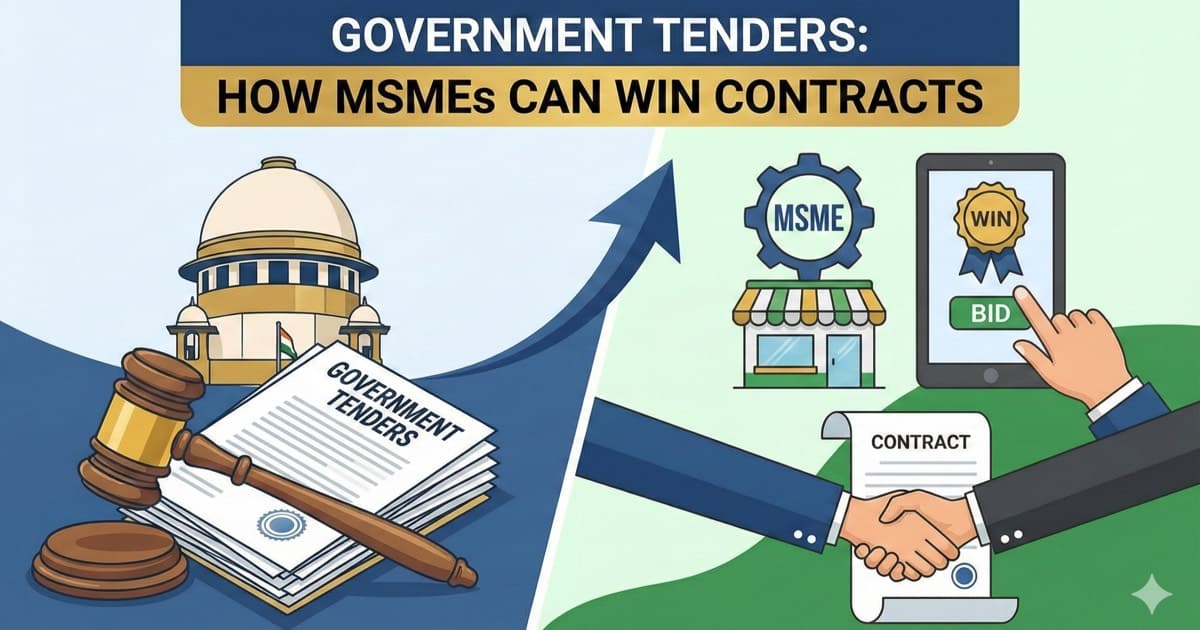
Government procurement offers MSMEs structured contracts with predictable payments and MSME-specific advantages. This guide covers where to find tenders (GeM and CPPP), MSME benefits like EMD exemption, bid preparation, and common disqualification mistakes.
The Opportunity
Government tenders for MSME represent a large, structured market where buyers follow documented processes and payments are backed by the exchequer. For many small businesses, public procurement offers predictability that private-sector deals often lack: requirements are published in advance, evaluation criteria are transparent, and payment terms are formalized.
If you're new to government tenders, start with GeM (Government e-Marketplace) for standard products and services. Once you build a track record of successful deliveries, you can move to eProcure/CPPP for larger, more complex contracts.
What You'll Learn
- How to find relevant tenders on GeM and CPPP with MSME-specific benefits like EMD exemption
- How to prepare a bid pack with the right documents to avoid technical disqualification
- How to win contracts by understanding evaluation criteria beyond price alone
Market Context
Current Scale
Central and state governments procure goods, services, and works worth lakhs of crores annually. A portion of this is earmarked for procurement from MSEs (Micro and Small Enterprises) under public procurement policies.
Why This Matters for MSMEs
- Structured demand: Government departments publish requirements formally, giving you time to prepare.
- Documented processes: Eligibility, technical criteria, and evaluation methods are disclosed upfront.
- Payment reliability: Once goods/services are accepted, payment follows a defined timeline (with MSME protections for delayed payments).
Why Now?
- Digital portals like GeM have made discovery and bidding easier than ever.
- MSME-focused policies (where applicable) reduce entry barriers through EMD exemptions and purchase preferences.
- Growing procurement volumes mean more opportunities across sectors—from office supplies to IT services to infrastructure works.
Who Can Benefit?
Ideal Businesses
- Manufacturers with products that match government specifications
- Service providers (IT, consulting, maintenance, security, housekeeping)
- Traders registered as MSMEs who can supply standardized goods
Required Capabilities
- Valid Udyam Registration to claim MSME benefits
- Ability to meet technical specifications and delivery timelines
- Working capital to fulfill orders before payment arrives
- Digital readiness (DSC, portal registration, online bid submission)
Many tenders provide MSME benefits (like EMD exemption or purchase preference), but not every tender does. Always read the tender's eligibility and bid conditions and upload the required proof (for example, your Udyam certificate) exactly as asked.
MSME Classification (for reference)
| Category | Investment | Annual Turnover |
|---|---|---|
| Micro | Up to ₹2.5 Crore | Up to ₹10 Crore |
| Small | Up to ₹25 Crore | Up to ₹100 Crore |
| Medium | Up to ₹125 Crore | Up to ₹500 Crore |
Source: msme.gov.in
Related guide: What is Udyam Registration? Complete Guide for MSMEs (2026)
How to Capitalize
Step 1: Register on the Right Portals
GeM (gem.gov.in) is the primary marketplace for central government procurement. Register as a seller, link your Udyam number, and list your products/services.
CPPP/eProcure (eprocure.gov.in) hosts larger, more complex tenders. Register and obtain a Digital Signature Certificate (DSC).
State portals handle state government procurement—start with your home state for local delivery advantages.
Step 2: Find and Filter Tenders
Search for tenders that match your products/services. Filter by:
- Scope match: product/service aligns to what you sell
- Delivery feasibility: timeline and location are realistic
- Eligibility match: turnover, experience, certifications you already have
If this is your first government contract, prioritize GeM and focus on getting 5–10 clean deliveries with strong ratings. That track record makes bigger tenders easier later.
Step 3: Read the Tender Documents Carefully
Most tender packages include:
- NIT / Tender Notice: dates, eligibility, EMD, submission instructions
- Technical specifications: what exactly must be supplied/delivered
- General/Special Conditions: penalties, warranty, payment, acceptance
- BOQ/Price schedule: where and how to quote price
Treat every tender like a compliance exam. If you miss a mandatory requirement or submit in the wrong format, you can lose even when your pricing and capability are strong.
Step 4: Prepare Your Bid Pack
- Udyam Registration certificate
- PAN and GST details
- Bank details (cancelled cheque) and authorized signatory proof
- Product/service brochures or compliance statement mapped to specs
- Past performance proofs (POs, completion certificates) if required
- Any certifications asked in the tender
- Signed declarations/undertakings exactly as per tender formats
If you supply products that require regulatory approvals, keep those proofs ready. Example: BIS certification for products in India
Step 5: Submit Early and Keep Proof
Portals slow down near deadlines. Aim to submit hours, not minutes, before closing.
After submission, download and save:
- Submission acknowledgement
- Uploaded document list
- Bid reference number
Step 6: Respond Fast During Clarifications
After bidding:
- Answer clarifications quickly and precisely
- Be ready for sample submission/inspection if asked
- Track amendments/corrigenda and update your bid if required
Risks and Considerations
Many tenders include liquidated damages for delay (typically 0.5% per week, capped at 10%) and strict inspection/acceptance clauses. Bid only when you can deliver with margin and buffer.
Risk Mitigation
- Cashflow planning: Arrange working capital before scaling up—you may need to procure and deliver before payment arrives.
- Realistic bidding: Don't bid on tenders where timelines or specifications are beyond your capacity.
- Payment escalation: If payment is delayed beyond 45 days, use the MSME Samadhaan portal to file a complaint.
Resources and Next Steps
Portals to register on:
MSME essentials:
Related articles:
- What is Udyam Registration? Complete Guide for MSMEs (2026)
- BIS Certification for Products: Complete Guide
Edited by Trade in Bharat Editorial Team