

Quick Summary
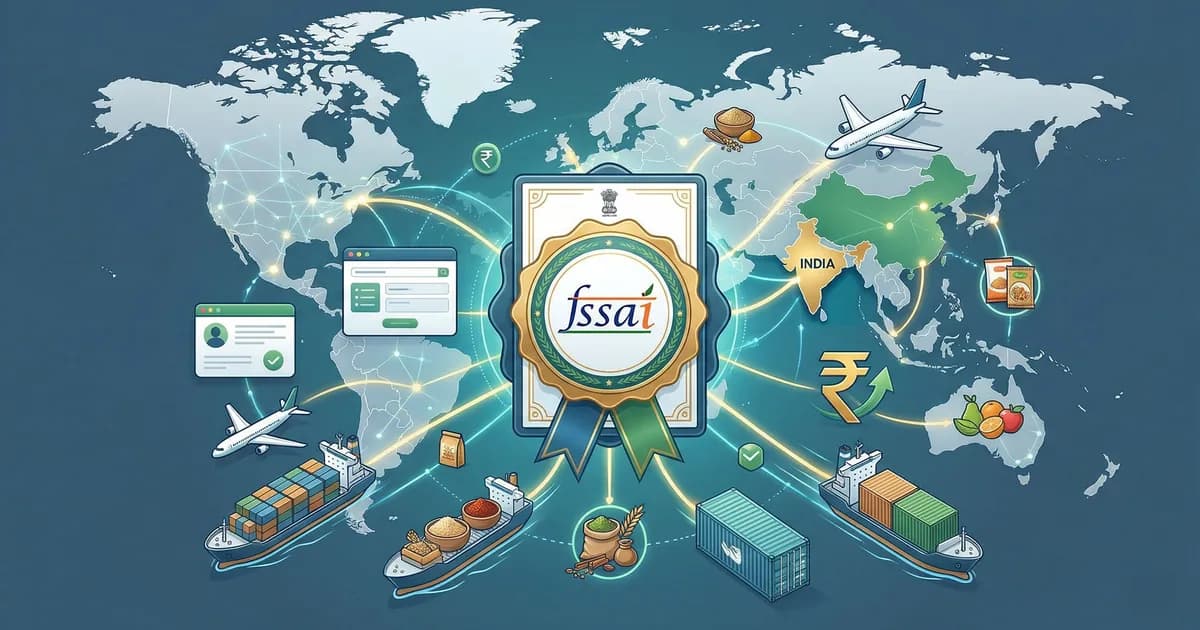
If you want to export food from India, getting an FSSAI license for food export is one of the core compliance steps you need to sort out early. Depending on your business model, you may need a Central FSSAI License — particularly if you are a 100% Export Oriented Unit, a large processor, or operate across multiple states (Schedule 1, Licensing Regulations). Applications are filed through the FoSCoS portal. This guide explains which license type applies, what documents you need, how the online process works, what it costs, and which mistakes delay approval.
What You'll Learn
- How to identify the correct FSSAI license type for your food export business
- What documents, fees, and FoSCoS steps you need before applying
- How to avoid rejection mistakes, renewal delays, and missing follow-up registrations
What is an FSSAI License for Food Export?
The Food Safety and Standards Authority of India (FSSAI) regulates food businesses under the Food Safety and Standards Act, 2006. Under Section 31 and the Licensing and Registration Regulations, every Food Business Operator must be registered or licensed.
Whether you need a Central or State license depends on your specific business activity. Under Schedule 1 of the Licensing Regulations, the Central Licensing Authority covers defined categories such as 100% Export Oriented Units, all importers, food processors with installed capacity above 2 MT/day, and operators working across two or more states. If your export business falls under any of these categories, you file for a Central FSSAI License through FoSCoS. Other food exporters not covered by Schedule 1 apply for a State License through the same portal.
Do not start the application until you have clearly identified your business model: manufacturer-exporter, merchant-exporter, or export-oriented unit. Choosing the wrong business activity or product category on FoSCoS is one of the easiest ways to delay approval.
Why this license matters
- It shows your business is legally recognized under India's food safety regime
- It is often checked alongside your export documents and buyer onboarding paperwork
- It supports traceability, labeling, hygiene, and compliance expectations in cross-border trade
Which FSSAI License Type Applies?
FSSAI has three broad licensing buckets.
| License Type | Who It Is For | Basic Fee | Application Form |
|---|---|---|---|
| Basic Registration | Petty food businesses with annual turnover up to ₹12 lakh | ₹100 per year | Form A |
| State License | Food businesses above ₹12 lakh but below Central thresholds | Varies by category | Form B |
| Central License | Food businesses listed in Schedule 1: 100% EOUs, importers, processors above 2 MT/day, multi-state operators, and other specified categories | ₹7,500 per year | Form B |
Your license type depends on which category your business falls under — not on export activity alone. Check Schedule 1 of the Licensing Regulations to confirm whether Central or State licensing applies to your specific operation.
Common exporter models
| Exporter Type | How It Works | What Changes in Documentation |
|---|---|---|
| Exporter-Manufacturer | You produce the food and export it yourself | Layout plan, machinery details, water analysis, FSMS details become more important |
| Merchant-Exporter | You source food from an Indian manufacturer and export under your own brand or trading firm | You usually need manufacturer details and, in many cases, an NOC or supporting authorization |
| Export-Oriented Unit (EOU) | You operate as a recognized export-oriented unit | Additional unit-specific approvals may apply |
A small spice trader in Kochi with only ₹8 lakh in turnover might assume Basic Registration is enough. But if the business is a recognized 100% Export Oriented Unit, or processes more than 2 MT/day, it falls under Schedule 1 and needs a Central License — regardless of turnover. Always check which Schedule 1 category, if any, applies to your operation before choosing a license type.
Documents and Prerequisites
Before you apply, get the basics in place. Most delays happen because the applicant starts FoSCoS first and document preparation later. If you still need your trade registration, start with this guide on how to get IEC (Import Export Code) before you file the food license.
- Import Export Code (IEC) from DGFT
- PAN and business constitution documents such as proprietorship proof, partnership deed, LLP agreement, or certificate of incorporation
- Address proof of the premises
- List of food products or food categories you handle
- Food Safety Management System (FSMS) plan
- Identity and address proof of proprietor, partners, or directors
- GST details if applicable to your business structure and operations
- Water analysis report and layout plan for manufacturing units
- NOC or manufacturer authorization where merchant-export model requires it
What should your FSMS plan include?
Many articles mention the FSMS plan but do not explain it. At a minimum, your plan should show:
- how raw materials are received and checked
- how products are stored, handled, and packed
- hygiene and sanitation controls
- pest control and cleaning practices
- traceability and batch identification
- complaint handling and recall process
If you manufacture food, this document is not a formality. It tells the licensing authority how you control food safety in daily operations.
Key prerequisites at a glance
| Requirement | Why You Need It |
|---|---|
| IEC | Essential for cross-border trade and often needed before downstream export registrations |
| Business proof | Confirms who is applying and under which legal entity |
| Premises details | FSSAI licensing is premise-based |
| Product clarity | Wrong food category selection can trigger objections or rejection |
| FSMS readiness | Helps during scrutiny and inspection |
If you are a merchant-exporter, collect product specifications, labels, and manufacturer authorization before filing. If the licensing authority requests additional information, you have only 30 days to respond — failing which the application is rejected (Regulation 2.1.4).
If you are setting up as a small manufacturer or MSME exporter, it also helps to understand what Udyam Registration is so your compliance stack is organized before you approach buyers and agencies.
Step-by-Step FSSAI License for Export Process
The application is filed online through FoSCoS.
Step 1: Check eligibility and select the right business activity
Visit FoSCoS and choose Apply for License/Registration. Select your state, then identify the correct kind of business and activity. Export businesses should be extra careful here because a wrong selection affects both the license category and the document list.
Step 2: Fill Form B carefully
Form B is used for license applications. You will enter:
- entity and communication details
- premises address
- food category details
- installed capacity, if you manufacture
- partner, director, or proprietor details
Make sure the business name, address, and entity type match your supporting documents exactly.
Step 3: Upload documents
Upload the required proofs, declarations, and technical documents. If you are a manufacturer, expect more scrutiny on layout plan, water report, and FSMS controls. If you are a merchant-exporter, your sourcing trail should be easy to explain.
Step 4: Pay the government fee
The Central License government fee is ₹7,500 per year (Schedule 3, Licensing Regulations). License validity can be chosen for 1 to 5 years, so the total government fee depends on the duration you select.
Step 5: Scrutiny and inspection
Under Regulation 2.1.4, the licensing authority must issue the license within 60 days from the date a complete application ID is assigned. During this period, the authority may request additional information or order a premises inspection. Incomplete applications — where the applicant fails to respond within the stipulated 30 days — are rejected outright.
Step 6: Download the license and display it
Once approved, download the license from FoSCoS and keep a copy displayed at the premises. The license is not just for customs-facing paperwork. It must also match your actual operating setup on the ground.
Fees, Validity, and Renewal Rules
Here is the cost picture for a Central FSSAI License, based on Schedule 3 of the Licensing Regulations.
| Validity Chosen | Government Fee |
|---|---|
| 1 year | ₹7,500 |
| 2 years | ₹15,000 |
| 3 years | ₹22,500 |
| 4 years | ₹30,000 |
| 5 years | ₹37,500 |
How long is the license valid?
The license can be taken for 1 to 5 years. Many exporters choose a longer validity if the product line and premises are stable, because it reduces repeat filing work.
When should you renew?
Under Regulation 2.1.7, renewal must be filed not later than 30 days before the expiry date. Applications filed after this deadline but before expiry must include a late fee of ₹100 per day of delay. If renewal is not filed within the allowed period (no later than 30 days after expiry), the license lapses and you must apply fresh before restarting operations.
Do not treat renewal as a last-week task. Once the expiry date is too close, daily late fees start adding up. If renewal is not filed within the allowed period, your business is expected to stop food activity at that premises until a fresh license is obtained.
One more compliance point most exporters miss
The licensing regulations also require licensees to file an annual return by 31st May each year. Under the regulations, any delay beyond this date attracts a penalty of ₹100 per day. If you are building a serious export business, put license renewal and return filing into the same compliance calendar.
Common Mistakes to Avoid
Assuming low turnover means Basic Registration is enough. Export activity changes the compliance picture. Do not decide the license type only from turnover.
Selecting the wrong food category on FoSCoS. This is one of the most common reasons applications get sent back for clarification.
Submitting a weak FSMS plan. A one-page generic note is rarely enough for a manufacturing exporter. Your controls should match your actual process.
Using mismatched entity details. If your PAN, incorporation document, address proof, and application form do not line up, expect queries.
Ignoring follow-up registrations. FSSAI is necessary, but for many exporters it is not the only registration.
Beyond FSSAI: What Else Might You Need?
FSSAI is a core food-business compliance requirement, but many food exporters need one or more additional registrations depending on the product.
| Registration | When It Matters | Official Reference |
|---|---|---|
| IEC | Required for import-export trade generally | DGFT |
| APEDA RCMC | For scheduled agricultural and processed food products | APEDA RCMC |
| Spices Board CRES | For exporters dealing in spices | Spices Board CRES |
| Destination-country certificates | For market-specific health, labeling, or phytosanitary requirements | Depends on product and country |
For example, APEDA states that exporters of scheduled products must obtain RCMC through the DGFT e-RCMC route. Spices exporters may also need registration with the Spices Board. So the right question is not only "Do I have FSSAI?" but also "What else does my product and buyer market require?"
Frequently Asked Questions
QDo small businesses also need a Central FSSAI License for food export?
Do not rely only on turnover to pick your license type. Check Schedule 1 of the Licensing Regulations to see if your business falls under a Central License category (such as 100% EOU, processor above 2 MT/day, or multi-state operator). If it does not, a State License may apply instead. Confirm on FoSCoS before filing.
QIs an FSSAI license enough to start exporting food?
Usually no. You will also need an IEC, and depending on the product, you may need APEDA registration, Spices Board registration, buyer-specific certifications, or destination-country health documents.
QCan a merchant-exporter apply without owning a factory?
Yes. A merchant-exporter can apply, but the sourcing arrangement must be clear. Keep manufacturer details, product information, and any required authorization or NOC ready before applying.
QWhat is the normal processing time for a Central FSSAI License?
Under Regulation 2.1.4 of the Licensing Regulations, the licensing authority must issue the license within 60 days from the date a complete application ID is assigned. If additional information is requested and the applicant does not respond within 30 days, the application is rejected.
QWhat happens if I renew late?
Under Regulation 2.1.7, if you file after the 30-day-before-expiry deadline but before the license expires, a late fee of ₹100 per day of delay applies. If renewal is not filed within 30 days after expiry, the license lapses and the business must stop food operations at that premises until a fresh license is obtained.
Official Resources
- FSSAI Registration and Licensing Overview
- FoSCoS License Application Portal
- Food Safety and Standards (Licensing and Registration of Food Businesses) Regulations
- APEDA RCMC Guidance
Related Articles
- BIS Certification for Products: Complete Guide for Manufacturers - Useful if you also deal with regulated manufactured products or adjacent compliance requirements
FSSAI procedures, fees, and document requirements can change over time. Always verify your exact eligibility and current filing requirements on the official FoSCoS portal before submitting the application.