

Quick Summary
Incoterms are the rulebook for who pays what and where risk passes when goods cross borders. Incoterms 2020, the current edition from the International Chamber of Commerce (ICC), has 11 three-letter terms, but most Indian exporters commonly use just three of them: FOB, CIF, and EXW. This guide walks through all 11 rules, goes deep on the three you will actually negotiate, explains what changed from Incoterms 2010, and shows how your Incoterm choice flows directly into your Shipping Bill value and export incentive claims.
What You'll Learn
- How Incoterms 2020 allocate cost, risk, and customs responsibility between seller and buyer
- What FOB, CIF, and EXW actually mean and when each one is the right choice
- How your Incoterm decision affects your Shipping Bill value and export incentives
What Are Incoterms?
Incoterms (short for International Commercial Terms) are a standardised set of three-letter rules published by the International Chamber of Commerce. Every Incoterm answers three questions in a single code.
- Who arranges transport, insurance, and export or import clearance?
- At what point does risk pass from seller to buyer?
- Who pays which cost along the way?
The current version, Incoterms 2020, entered into force on 1 January 2020 and is maintained by the ICC. It contains 11 rules, grouped by mode of transport.
An Incoterm is not a price term. It is a contract clause that decides who carries the cost and the risk at every leg of the journey. Treat it that way in every quotation.
The 11 Incoterms 2020 at a Glance
The 11 rules split into two groups based on which transport mode they fit.
For Any Mode of Transport (sea, air, road, rail, multimodal)
| Rule | Full Name | Main Carriage Handled By |
|---|---|---|
| EXW | Ex Works | Buyer |
| FCA | Free Carrier | Buyer |
| CPT | Carriage Paid To | Seller |
| CIP | Carriage and Insurance Paid To | Seller |
| DAP | Delivered at Place | Seller |
| DPU | Delivered at Place Unloaded | Seller |
| DDP | Delivered Duty Paid | Seller |
For Sea and Inland Waterway Transport Only
| Rule | Full Name | Main Carriage Handled By |
|---|---|---|
| FAS | Free Alongside Ship | Buyer |
| FOB | Free On Board | Buyer |
| CFR | Cost and Freight | Seller |
| CIF | Cost, Insurance and Freight | Seller |
The ICC is specific about this split. FAS, FOB, CFR, and CIF should not be used for containerised cargo handed over at a terminal before loading. For container shipments the correct rules are FCA, CPT, or CIP. This matters because an exporter quoting FOB on a container shipment is technically using the wrong rule, and that can create insurance-claim problems if something goes wrong at the port.
FOB, CIF, and EXW in Detail
Three terms cover almost every Indian export quotation. Here is what each actually means.
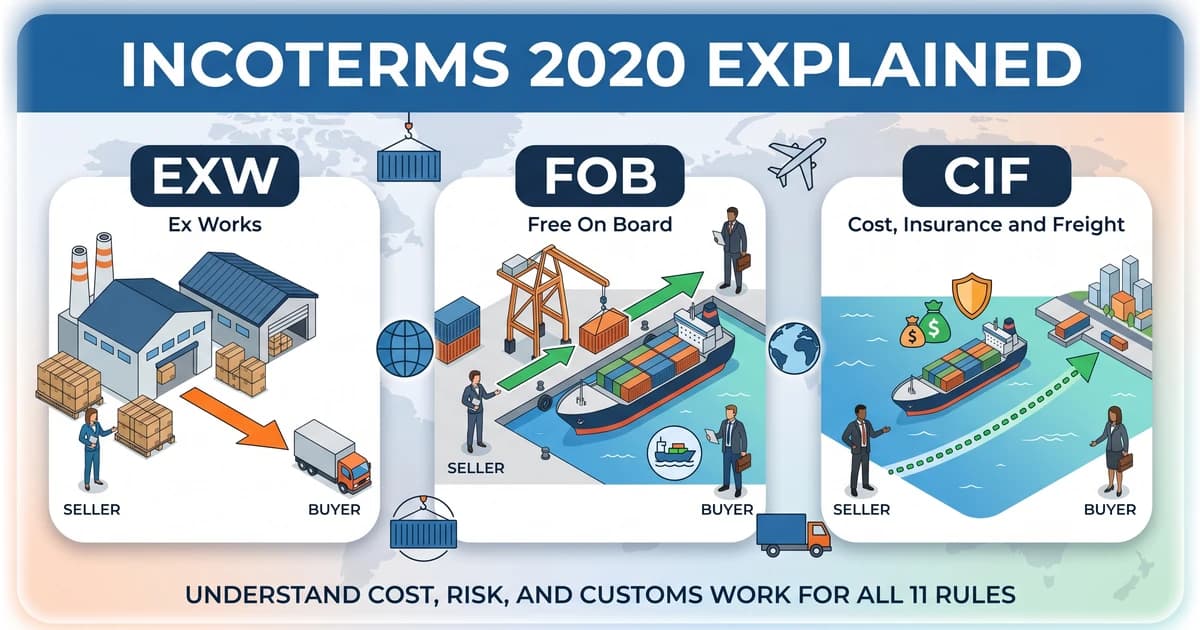
EXW (Ex Works)
Under EXW, the seller makes the goods available at their own factory, warehouse, or depot. Everything after that (loading, inland transport, export customs, main carriage, import customs, delivery) is the buyer's responsibility and risk.
This sounds attractive for a first-time exporter who wants to avoid logistics. It is usually a bad idea for international sales. Export customs clearance in India requires an IEC and a Shipping Bill filed on ICEGATE in the name of the person exporting the goods. A foreign buyer has no IEC and no standing before Indian customs, so either the seller still files the Shipping Bill under EXW (making the rule a fiction), or the shipment stalls.
Use EXW when: You are selling to another Indian trading house that will handle its own export paperwork.
FOB (Free On Board)
Under FOB, the seller delivers the goods on board the vessel nominated by the buyer at the named port of shipment. The seller handles inland transport, export clearance, and loading. The buyer handles ocean freight, insurance, and everything from destination port onwards. Risk passes from seller to buyer the moment the goods are on board the ship.
FOB is the most common quote from Indian exporters because it matches how the ICEGATE system works. The Shipping Bill captures FOB value, and most Indian export incentives such as RoDTEP and Duty Drawback are calculated on FOB value. Quoting in FOB keeps the exporter's paperwork and incentive calculations clean.
Use FOB when: Shipping bulk cargo on sea freight where the buyer has a freight forwarder at destination and wants to control ocean freight costs.
CIF (Cost, Insurance and Freight)
Under CIF, the seller does everything FOB requires and also books ocean freight to the destination port and pays for cargo insurance. Despite that, risk still passes when the goods are loaded on board at the port of loading, not at destination. That split between cost and risk is what trips up most new exporters.
Under Incoterms 2020, CIF insurance defaults to Institute Cargo Clauses (C), a limited named-perils cover. If the buyer wants broader all-risks cover they must agree with the seller to upgrade, typically to Institute Cargo Clauses (A). This is one of the most common Letter of Credit negotiation points, so read the insurance clause carefully before accepting the LC.
Use CIF when: The buyer is unfamiliar with shipping logistics, or you have better freight rates than the buyer would get.
A Surat textile exporter quotes two prices to a UK buyer. FOB Mundra at $4.00 per metre, or CIF Felixstowe at $4.35 per metre. The extra $0.35 covers ocean freight and insurance. If the buyer has a freight forwarder that can move the container for $0.28 per metre, they will take FOB and book their own freight. If they want a single landed price with no logistics work, they will take CIF.
What Changed in Incoterms 2020 vs 2010
The ICC updates the rules roughly every ten years. Four changes from the 2010 edition are worth knowing.
- DAT renamed to DPU. The old Delivered at Terminal term was replaced by Delivered at Place Unloaded because the word terminal caused confusion. DPU can be used for any unloading point, not just a terminal.
- CIP insurance upgraded. Under 2010, both CIF and CIP defaulted to Institute Cargo Clauses (C). Under 2020, CIP now requires Institute Cargo Clauses (A), the broader all-risks cover. CIF still defaults to Clauses (C).
- FCA bill of lading clause. FCA now allows the buyer to instruct its carrier to issue an on-board bill of lading to the seller after loading. This was added specifically to fix a long-running problem with letters of credit that required an on-board bill under FCA sales.
- All costs consolidated. Every rule now lists costs under article A9/B9, so both parties can see the full cost picture in one place instead of hunting through multiple clauses.
How Incoterms Affect Your Shipping Bill and Export Incentives
This is where most Indian exporters get tripped up. The Incoterm you quote to your buyer flows directly into your Shipping Bill on ICEGATE, which flows into your incentive calculations.
The Shipping Bill requires the declaration of both FOB Value and Invoice Value. If you quote CIF, your invoice value will be higher than your FOB value by the amount of freight and insurance. Indian customs treats FOB value as the basis for most export incentives, including RoDTEP and Duty Drawback. RoDTEP in particular applies the notified rate to FOB value subject to per-unit value caps set by DGFT, so your declared FOB flows directly into the incentive calculation up to that cap.
Quoting FOB to your buyer and then paying ocean freight yourself to help them out is the classic Indian exporter trap. You have legally contracted for FOB, so the freight payment is not part of your invoice, cannot be claimed in your Shipping Bill, and does not count toward any export incentive. You have effectively subsidised the buyer's freight out of your margin. If you are going to pay the freight, quote CFR or CIF instead so the cost appears in your invoice and your records.
How to Pick the Right Incoterm
There is no single right answer. Three practical rules cover most first-time export decisions.
- If the buyer insists on a single landed cost, quote CIF or CFR. You control the freight, your margin is visible, and your paperwork is clean.
- If the buyer has a freight forwarder, quote FOB. They control their freight cost, you keep your paperwork simple, and your Shipping Bill FOB value matches your invoice.
- Avoid EXW for international sales. Export clearance in India requires an Indian IEC, so the seller almost always ends up handling it anyway, which makes EXW a fiction.
For your first ten export orders, default to FOB unless the buyer specifically asks for CIF. It is the cleanest match for the ICEGATE Shipping Bill, it aligns with RoDTEP and duty drawback calculations, and it gives you one less moving part to manage while you learn the logistics.
What Your Incoterm Clause Must Specify
The three letters alone are not enough. An Incoterm clause in a contract or invoice must always include three things.
- The three-letter rule (e.g., FOB, CIF, EXW, CIP)
- The named place or port (FOB Mundra, CIF Felixstowe, never just FOB)
- The edition year (Incoterms 2020) so there is no doubt about which rulebook applies
A clause written as FOB Mundra Port, Incoterms 2020 is enforceable. A clause written as just FOB is ambiguous and can cause disputes on both cost and risk.
Common Mistakes to Avoid
- Using FOB, CFR, or CIF for container cargo. These sea-only rules assume bulk loading over the ship's rail. For containers handed to a carrier at a terminal before loading, use FCA, CPT, or CIP. The risk-transfer point is different.
- Skipping the named place. An Incoterm without a named place is legally incomplete. Always write the port or place next to the rule.
- Confusing CIF risk with CIF cost. The seller pays freight and insurance to destination, but risk passes at the port of loading. The buyer files an insurance claim for in-transit loss, not the seller.
- Quoting DDP without understanding destination tax. DDP makes the seller responsible for import duty and VAT or GST at the buyer's country. Most first-time exporters should not quote DDP unless they have an import agent in the destination country.
Frequently Asked Questions
Which Incoterm is most commonly used by Indian exporters?
FOB is the default for Indian sea freight. It aligns with the Shipping Bill FOB value that ICEGATE captures and with the basis on which RoDTEP and Duty Drawback incentives are calculated.
Is there an Incoterms 2025 or 2026?
No. The current version is Incoterms 2020. The ICC has historically updated the rules roughly once a decade (1990, 2000, 2010, 2020), so a refresh in the coming years is likely, but there is no published timetable for the next edition. Always reference Incoterms 2020 in your contracts until the ICC publishes a new edition.
Can I mix Incoterms in a single contract?
You can use different Incoterms for different shipments under a master contract, but each individual shipment or line item must reference one Incoterm with its named place. Mixing without specifying per shipment is a common source of payment disputes.
Does the Incoterm affect my GST treatment?
Exports remain zero-rated under GST regardless of the Incoterm. The Incoterm affects your invoice value, which in turn affects any refund or rebate computation where invoice value matters. The bigger GST exposure is with DDP, where the seller may take on destination-country import tax responsibilities.
What is the difference between CIF and CIP?
Both require the seller to pay for carriage and insurance to the destination. CIF is a sea-only rule with risk passing when goods are on board at the origin port, and insurance defaults to Clauses (C). CIP works for any transport mode, with risk passing when goods are handed to the first carrier, and insurance requires the broader Clauses (A) cover.