
Quick Summary
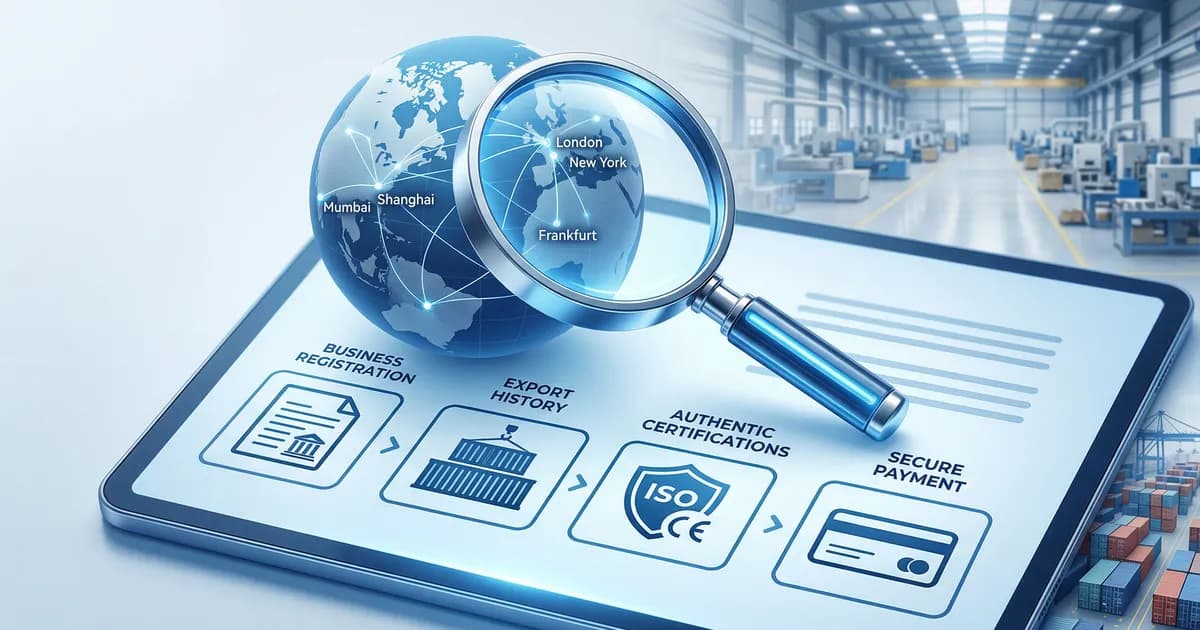
Supplier fraud and quality failures are among the most common risks Indian importers face. A structured verification process — done before you transfer any money — filters out bad actors and gives you the confidence to proceed. This guide covers an 8-step supplier verification checklist, from checking business registration and export history to India-specific compliance requirements like BIS certification, DGFT restricted import rules, and RBI-compliant payment structures.
What You'll Learn
- How to verify a foreign supplier's registration, certifications, and export history before placing an order
- What documents to request and which red flags to watch for, including the 2025 AI deepfake factory tour threat
- How to meet India's compliance requirements — BIS, FSSAI, DGFT, and FEMA-safe payment structure
Why Supplier Verification Matters
Every year, Indian importers lose money to supplier fraud, counterfeit goods, and poor-quality shipments. A supplier who looked credible online turns out to have no real factory, sends products that fail BIS inspection, or disappears after receiving an advance payment.
Most of these problems are preventable. A structured verification process done before you commit any funds will filter out the bad actors and surface the genuine ones.
Your Supplier Verification Checklist
Step 1: Check Business Registration
The first thing you check is whether the supplier actually exists as a registered legal entity.
For Chinese suppliers (India's largest import source), verify on GSXT (gsxt.gov.cn) — China's official National Enterprise Credit Information System. Search the supplier's name to find their Unified Social Credit Code (18-character identifier), registration status, shareholders, and any administrative penalties or abnormal business listings.
For suppliers from other countries:
- UK: Companies House (companieshouse.gov.uk)
- USA: SEC EDGAR or the relevant state business registry
- EU: European Business Register
Third-party aggregators like Qichacha and Tianyancha provide more detailed information on Chinese companies — including litigation history, court judgments, and debt-default blacklist status.
Any supplier who only provides a Gmail or Yahoo address with no corporate domain, or lists a P.O. box instead of a physical factory address, is immediately suspect. Legitimate manufacturers have proper business addresses and branded email domains.
Step 2: Verify Export History with Trade Data
A supplier can claim anything on their B2B profile. Actual shipment records are harder to fake.
Use these platforms to check real export activity:
| Platform | Data Coverage | Cost |
|---|---|---|
| ImportYeti | US bills of lading (2015 onwards) | Free |
| Panjiva | 30+ countries, 10M+ businesses | Paid |
| Volza | 203 countries, buyer-supplier mapping | Paid |
| ImportGenius | 23+ countries | Paid |
Search the supplier's company name to confirm they have genuine shipment records, consistent buyer relationships, and regular trade activity. A supplier claiming 10 years of experience but showing zero records anywhere needs a convincing explanation.
Step 3: Authenticate Certifications
Certification fraud is common. A supplier may show you a fake ISO or CE certificate that looks convincing but doesn't hold up to scrutiny.
Always verify directly on the issuing body's official database:
- SGS: sgs.com
- TUV SUD (Certipedia): certipedia.com
- Intertek: cert-database.com
- Bureau Veritas: bvcert.com
The most commonly faked certifications are ISO 9001, CE marking, and RoHS compliance. If a certificate number doesn't return a valid result on the official portal, don't proceed.
Request the certificate, then verify the certificate number yourself on the issuing body's website. Never accept a supplier's word that a certification is valid — always check at the source.
Step 4: Request Key Documents
A legitimate supplier will share these without hesitation:
- Business registration certificate or Certificate of Incorporation
- Export license from their home country
- Product certifications relevant to your category (ISO, CE, GMP, etc.)
- Accredited lab test reports for the specific product
- Sample commercial invoice and Bill of Lading from a past shipment
- Bank account details (company name must match registration exactly)
One quick test: ask for their bank account details. If the account name doesn't match the registered company name, stop immediately. Payments routed to personal accounts are the most common setup for advance payment fraud.
Step 5: Get a Credit Report
For first-time, high-value orders, run a financial credibility check on the supplier.
ECGC (Export Credit Guarantee Corporation of India) provides credit risk assessments on foreign entities. Indian importers can request a supplier credit report through their bank or directly at ecgc.in.
Global credit bureaus like Dun & Bradstreet also offer international company credit reports — useful for verifying financial stability and payment track record before committing to a large order.
Step 6: Order and Test Samples
No verification step replaces physically testing the product. Always order samples before committing to a bulk order.
Samples let you verify product quality against your specifications, check for India-specific compliance (BIS marking, FSSAI labeling), and evaluate how the supplier handles the transaction professionally. For how to write professional sample request emails and understand India's duty-free customs exemption for samples, see our guide on how to request product samples from suppliers.
Step 7: Arrange a Factory Audit
Before a large first order, a factory audit gives you ground truth on the supplier's actual production capacity and working conditions.
You have two options:
Virtual factory tour via a live video call. Ask for a walkthrough of specific production areas and have the supplier perform an unscripted real-time action — hold up today's newspaper, point to a specific machine, write your company name on a whiteboard. This confirms it's a live feed.
Third-party inspection by an independent company like Intertek, SGS, Bureau Veritas, or AsiaInspection. On-site factory audits typically cost $300–$1,500. A pre-shipment inspection (PSI) before final payment release is the single most effective financial safeguard available.
In 2025, AI deepfake video factory tours have emerged as a real fraud tactic. Sophisticated AI tools can simulate convincing live factory walkthroughs. Always request an unscripted real-time action to confirm you're seeing a genuine live feed and not pre-generated footage.
Step 8: Structure the Transaction Safely
How you pay is as important as who you pay.
Never pay 100% upfront. The standard structure for first-time orders is 30% advance to begin production and 70% after pre-shipment inspection and document verification.
For large or high-risk orders, a Letter of Credit (LoC) through your bank is the safest route — your bank releases payment only when the supplier presents a complete, compliant set of shipping documents.
On Alibaba, Trade Assurance functions as escrow and is a practical option for smaller orders. Avoid payments via Western Union, cryptocurrency, or personal bank accounts — these channels offer zero buyer protection.
All import payments must go through an AD (Authorised Dealer) Category-I bank authorized by RBI. Payments outside this channel violate FEMA (Foreign Exchange Management Act). Penalties under Section 13 can reach up to 3x the original transaction amount.
Red Flags to Watch For
Stop or slow down if you see any of these:
- Prices significantly below the market average for your product (get 5-6 quotes to benchmark)
- Supplier only has a mobile number or free email with no corporate domain
- Refuses to share business registration documents or certifications
- Certificate numbers don't verify on the issuing body's official portal
- Requests 100% advance payment before production begins
- Bank account name doesn't match the registered company name
- Creates urgency with "last-day discount" or "overstock" pressure tactics
- Avoids video calls or refuses third-party factory audits
India-Specific Compliance Checks
Global verification gets you halfway. Importing to India comes with an additional compliance layer that you must confirm at the supplier level before finalizing any order.
BIS Certification
BIS (Bureau of Indian Standards) certification is mandatory for 450+ product categories in India. As of 2025, India has issued 187 Quality Control Orders (QCOs) covering 679+ product categories.
For products covered by a QCO, your foreign supplier must hold a valid BIS license to be eligible for import. Two schemes apply to foreign manufacturers:
- FMCS (Foreign Manufacturer Certification Scheme): For most non-electronics products
- CRS (Compulsory Registration Scheme): For electronics and IT products
Verify your supplier's BIS license number on bis.gov.in. Importing goods without valid BIS certification leads to confiscation at customs and penalties for the importer. For full details, see our guide on BIS certification for products.
Product-Specific Indian Certifications
Depending on what you're importing, confirm your supplier complies with:
| Product Category | Certification Required |
|---|---|
| Electronics, IT hardware | BIS CRS |
| Food products, health supplements | FSSAI approval |
| Wireless devices, IoT, routers | WPC (Wireless Planning and Coordination Wing) |
| Pre-packaged goods | LMPC (Legal Metrology Packaged Commodities) |
| Pharmaceuticals, medical devices | CDSCO |
| Electronics and batteries | EPR (Extended Producer Responsibility) registration |
Ask your supplier to provide documentation for the relevant certification before you finalize the order. Discovering a compliance gap after goods arrive at the port is expensive and time-consuming to resolve.
DGFT Restricted Imports
Before committing to any supplier, check whether your product is on DGFT's restricted or prohibited import list. Some products require a special import license or advance authorization from DGFT before you can import legally. Check the current list at dgft.gov.in.
Your supplier passing every global verification check means nothing if the product is restricted under India's Foreign Trade Policy. Always confirm DGFT import status before placing an order.Frequently Asked Questions
How do I verify a Chinese supplier for free?
Start with GSXT (gsxt.gov.cn) for official business registration records and ImportYeti for free US shipment data. For certifications, verify directly on the relevant issuing body's website — SGS, TUV, Intertek, or Bureau Veritas — at no cost. These three free resources cover business legitimacy, actual trade history, and certification authenticity.
Is a Verified Supplier badge on Alibaba enough?
No. Alibaba's "Gold Supplier" status confirms only a paid membership, not product quality or legal compliance. "Verified Supplier" means a third party (SGS, Intertek, or TUV) conducted an on-site audit, which is more meaningful. But it still doesn't guarantee BIS compliance for India or the supplier's current financial health.
What if a supplier fails verification?
Stop the transaction. Don't proceed hoping it will work out. Document what you found and move to the next supplier on your shortlist. The cost of failing verification (fraud, compliance rejection at customs, quality disputes) is always higher than the cost of switching suppliers before any money is committed.
Can I use the same process for Indian suppliers?
Yes, with local equivalents. For Indian suppliers, check the MCA (Ministry of Corporate Affairs) portal at mca.gov.in for registration status, verify GST numbers on the GST portal, and confirm Udyam registration if they claim MSME status. The Indian Business Portal at indianbusinessportal.in maintains verified Indian exporter listings.
Related Resources
- BIS Certification for Products: What Indian Importers Must Know
- How to Request Product Samples from Suppliers
- How to Get Your IEC (Import Export Code)
- FSSAI License for Food Products
- DGFT — Directorate General of Foreign Trade
- ECGC — Supplier Credit Risk Reports
Sourcing from India instead of importing? Tradoi.com, our parent company, lists only Tradoi Verified Indian sellers, so a business cannot list there until it passes the kind of checks this guide walks you through.