

Quick Summary
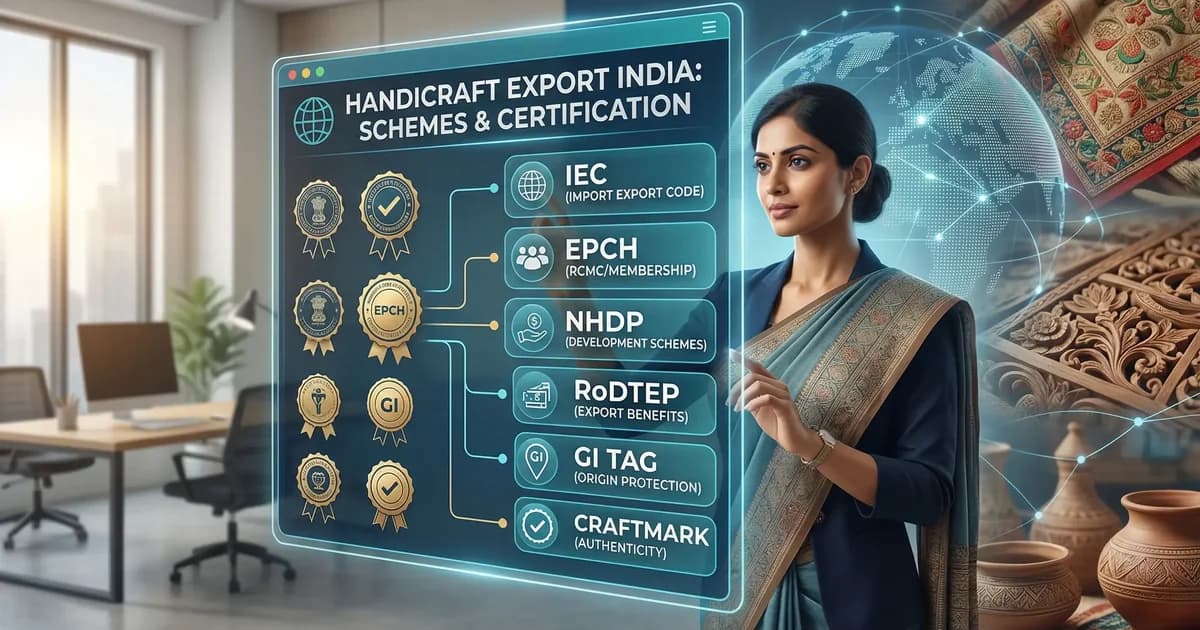
Handicraft export India is not only about finding a buyer and shipping products overseas. The stronger advantage comes from the support stack around the sector: EPCH membership and RCMC, Ministry of Textiles schemes, export incentives such as RoDTEP, and trust-building markers such as GI tags and Craftmark. This guide explains which schemes and certifications matter, who should use them, and how to prioritize them without wasting time or money.
What You'll Learn
- What registrations and certifications help a handicraft exporter access official support
- Which government schemes can reduce costs, improve market access, and strengthen product positioning
- How to prioritize EPCH, GI, Craftmark, and scheme applications based on your product and export model
Handicraft Export India: Why Policy Support Matters
According to IBEF, India's handicraft exports were valued at US$ 3.89 billion in FY25, and the sector supports more than 7 million people across hundreds of clusters. That matters because handicrafts compete on story, authenticity, design, and buyer trust as much as on price.
This also means the sector needs a different support model from generic manufacturing exports. A handicraft exporter may need help with buyer discovery, design improvement, authenticity claims, origin protection, and sometimes material-specific certificates. The good news is that India already has a policy and institutional ecosystem for this. The challenge is knowing which part of it actually applies to your business.
If you are still setting up your export basics, start with How to Get IEC and How to Find HS Code for Your Product. Those two steps sit underneath most downstream schemes and export incentives.
Registrations to Put in Place First
Before you chase schemes or certifications, get the basics right.
| Registration | Why It Matters | Where It Comes From |
|---|---|---|
| IEC | Mandatory for import-export transactions | DGFT |
| EPCH membership / RCMC | Opens sector-specific support, council services, and export representation | EPCH |
| GST registration | Needed in many business setups for invoicing and tax compliance | GST system |
| Udyam registration | Helpful if you want MSME-linked benefits and easier positioning as a manufacturer exporter | What is Udyam Registration? |
- Import Export Code (IEC) from DGFT
- Clear business model: merchant exporter, manufacturer exporter, or merchant-cum-manufacturer
- Correct HS code mapping for your product line
- Basic business documents such as PAN, entity proof, bank details, and address proof
- Product clarity on materials used, especially if you may need GI, Craftmark, or CITES-related documentation
EPCH membership and RCMC, in plain terms
The Export Promotion Council for Handicrafts was established to promote and support handicraft exports from India. EPCH states that its membership is a pre-condition for obtaining its Registration-cum-Membership Certificate (RCMC). Current fees listed on the official EPCH site are:
- Entrance fee: ₹2,500 in the year of enrollment
- Annual membership fee: ₹5,000
- First-year total with 18% GST: ₹8,850
- Annual renewal with GST: ₹5,900
EPCH also notes that RCMC can be issued as merchant exporter, manufacturer exporter, or merchant-cum-manufacturer exporter, depending on your documents. That distinction matters. A merchant exporter mainly needs supplier control and export execution. A manufacturer exporter is expected to show stronger production evidence, and EPCH asks for supporting proof such as Udyam or similar manufacturing evidence for that status.
EPCH registration is not a magic export license. It does not replace IEC, product compliance, or buyer-country rules. What it does give you is a formal place inside the handicraft export ecosystem, which becomes useful for fairs, sector notifications, certifications, and scheme-linked support.
Government Schemes Supporting Handicraft Exporters
The most useful schemes are not all cash subsidies. Some reduce hidden costs, some improve design and cluster capability, and some help you access buyers.
| Scheme / Support | What It Does | Why It Matters for Exporters |
|---|---|---|
| National Handicrafts Development Programme (NHDP) | Core development scheme under the Office of the Development Commissioner (Handicrafts) | Supports marketing, skilling, infrastructure, artisan welfare, and R&D |
| Comprehensive Handicrafts Cluster Development Scheme (CHCDS) | Cluster-focused infrastructure and competitiveness support | Useful where export capacity depends on cluster strength, not just one firm |
| RoDTEP | Remits embedded duties and taxes on eligible exports | Helps protect margins on export shipments |
| Interest Equalization Scheme | Interest support on eligible export credit lines | Useful for working-capital-heavy exporters |
| MAI / MDA support through EPCH-led activities | Helps participation in fairs and market-promotion activities | Reduces cost of market access and buyer discovery |
| ODOP / state initiatives | Branding, training, or market support for district-linked products in some states | Helpful for region-specific crafts and clusters |
What sits inside NHDP
Official Development Commissioner (Handicrafts) material and NHDP guideline references show six broad components inside the programme:
- Marketing Support and Services
- Skill Development in the Handicraft Sector
- Ambedkar Hastshilp Vikas Yojana
- Direct Benefit to Artisans
- Infrastructure and Technology Support
- Research and Development
This is why NHDP matters. It is not a one-line subsidy. It is a framework that connects artisan welfare, design support, marketing exposure, and infrastructure. If you source from a cluster or work closely with artisans, NHDP-linked interventions can improve export readiness indirectly but materially.
RoDTEP and Interest Equalization
For shipment-level economics, RoDTEP matters more than many new exporters realize. DGFT describes the scheme as a mechanism to reimburse eligible embedded duties, taxes, and levies on exported products through transferable e-scrips. The exact benefit depends on the notified tariff lines and prevailing appendices, so you should always check your product's treatment on the official DGFT RoDTEP page.
The Interest Equalization Scheme can also matter if your handicraft export business uses working capital aggressively, especially when buyer cycles are long. EPCH's policy resources specifically include scheme procedures, FAQs, and covered items for handicraft exporters.
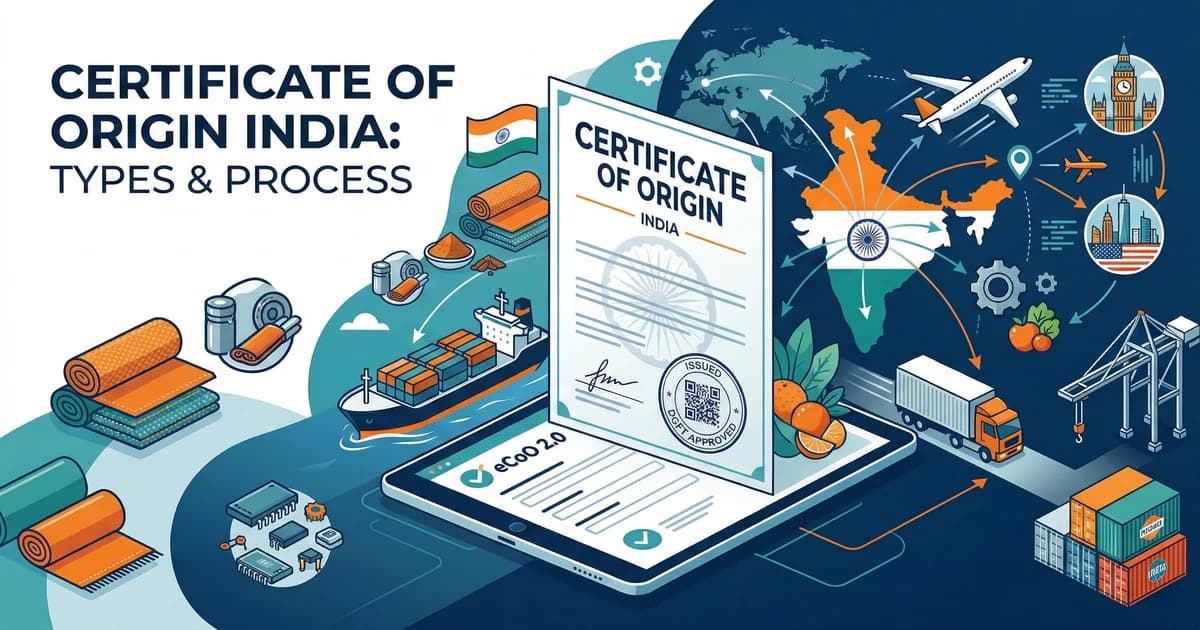
If you plan to use either benefit seriously, read Certificate of Origin India: Types and How to Obtain as well. Duty competitiveness and export incentive planning work better when your origin documents, HS codes, and export declarations are all aligned.
Certifications That Build Trust, Not Just Compliance
Not every handicraft exporter needs every certification. The right question is: which proof helps your product, market, and buyer conversation?
RCMC, GI tags, Craftmark, and CITES-related certificates solve different problems. One proves sector registration, another protects origin, another signals handmade authenticity, and another deals with restricted biological materials.1. RCMC through EPCH
For handicraft exporters, RCMC is the main sector-recognition document. It helps establish that you are registered within the export promotion ecosystem for handicrafts and gives access to council-driven services and support. It is especially useful when you want to participate in fairs, seek industry representation, or access FTP-linked sector assistance through EPCH.
EPCH issues RCMC with a validity of 5 years, but the certificate stays active only if you pay the annual membership subscription every year by 30 June. Missing an annual payment effectively suspends your RCMC privileges even within the 5-year window, so treat the renewal as a fixed calendar obligation, not an optional one.
2. GI tags
If your product is tied to a specific geography and recognized traditional process, a Geographical Indication (GI) can be commercially powerful. The official GI Registry process explains that eligible producer groups or associations file through the GI Registry in Chennai, and a registered GI is valid for 10 years with renewal.
For exporters, a GI does two things well:
- It helps defend origin-linked reputation
- It supports premium positioning for traditional crafts
But note the practical limit: a GI is not a quick solo certificate for one trader. It usually sits at the producer-group or regional level, so its value depends on whether your product is already part of a recognized GI ecosystem.
3. Craftmark
Craftmark, operated by AIACA, is a handmade authenticity mark for craft-based products and organizations. This is different from a GI. Craftmark does not say the product comes from a specific geography. It says the product meets the standard of being genuinely handmade through recognized craft processes.
That can be useful for exporters selling to buyers who care about handmade authenticity, artisan stories, and ethical sourcing narratives, especially in gift, lifestyle, and premium décor segments.
4. CITES and material-linked certificates
Some handicraft categories involve wood, plant, shell, leather, or wildlife-linked materials that can trigger additional controls. EPCH's official FAQ states that it supports members through CITES approved Vriksh Certificate services. This is not relevant to every exporter, but it matters a lot if your materials fall in a regulated category.
Many exporters waste time applying for certificates because they sound impressive. Do not do that. GI matters only when origin is genuine and recognized. Craftmark matters when handmade authenticity helps the buyer decision. CITES matters only for regulated materials. Start from your product and market, not from a random checklist.
Institutional Support Beyond Cash Incentives
A lot of the real support in handicraft export comes from institutions, not from one-time grants.
EPCH support
According to EPCH's official FAQ, members can access:
- commercially useful export information
- quality, design, standards, and product-development advice
- workshops on export marketing, procedures, packaging, and documentation
- international trade-fair participation and buyer-seller interactions
- financial support in council-led activities under MDA and MAI
EPCH also organizes the IHGF Delhi Fair, which official EPCH fair material describes as a major sourcing platform for global buyers, with recent editions listing 3,000+ exhibitors across multiple halls at Greater Noida. For many handicraft businesses, this is one of the clearest routes to buyer exposure that is still grounded in the sector.
Development Commissioner (Handicrafts) support
The Office of the Development Commissioner (Handicrafts) remains the core government institution behind sector development. Official materials show:
- a toll-free handicraft helpline: 18002084800
- support through NHDP and CHCDS
- a network of Regional Design and Technical Development Centres
Official references also point to five Regional Design and Technical Development Centres in New Delhi, Mumbai, Bengaluru, Kolkata, and Guwahati. For exporters, this matters because product adaptation and design refinement often decide whether a craft sells internationally or remains only locally appreciated.
State and district support
State initiatives and district branding programmes can add another layer of support, especially for well-known craft clusters. Treat these as opportunity multipliers, not as guaranteed pan-India subsidies. If your product belongs to a strong regional cluster, it is worth checking whether state export promotion agencies, ODOP programmes, or craft development bodies are already promoting that craft.
What New Exporters Should Do First
Do not chase every scheme at once. Build your support stack in the same order your export business matures: legal basics first, sector registration second, trust markers third, and advanced scheme optimization after that.
- Get the export foundation in place with IEC, GST position, and correct HS codes.
- Decide your exporter model: merchant exporter, manufacturer exporter, or merchant-cum-manufacturer.
- Join EPCH if handicrafts will be a serious business line, not an occasional shipment.
- Pick only the certifications that match your product reality: RCMC first, then GI, Craftmark, or CITES-related support where relevant.
- Use institutional channels early by tracking EPCH fairs, workshops, and DCH design support instead of relying only on random B2B marketplaces.
If your product has strong geographic identity, origin and branding should be part of your pricing strategy. If your product competes on repeatability and scale, design support and buyer access may matter more than GI.
Frequently Asked Questions
QIs EPCH registration mandatory to export handicrafts from India?
Not for every shipment. Your core legal export requirement is the IEC. But EPCH membership is the practical route if you want sector-specific RCMC, official council support, handicraft certifications through EPCH channels, trade-fair access, and policy-linked assistance.
QCan a merchant exporter also register with EPCH?
Yes. EPCH allows registration as merchant exporter, manufacturer exporter, or merchant-cum-manufacturer exporter. If you apply as a manufacturer exporter, EPCH asks for supporting evidence such as Udyam or similar manufacturing proof.
QIs a GI tag compulsory for handicraft exports?
No. A GI tag is useful only when your product is genuinely linked to a recognized geographic tradition and is part of a producer-group or regional GI ecosystem. Many handicraft exports happen without GI protection.
QDoes Craftmark replace a GI tag?
No. Craftmark and GI solve different problems. Craftmark supports handmade authenticity. A GI tag protects origin-linked identity tied to a specific region and tradition.
QWhich scheme helps most with buyer discovery and export visibility?
For many handicraft exporters, EPCH-led trade fairs, buyer-seller meets, and MAI or MDA-linked activities are more immediately useful than waiting for a broad subsidy. They put your product in front of real buyers and help you understand market fit faster.
Official Resources
- EPCH Membership Registration
- EPCH FAQ for Membership and Services
- About EPCH
- Development Commissioner (Handicrafts) Schemes
- DGFT RoDTEP Portal
- GI Registration Process - Intellectual Property India
- Craftmark Official Site
- IBEF Handicrafts Industry Overview
Related Articles
- How to Get IEC (Import Export Code): Complete 2026 Guide
- How to Find HS Code for Your Product: Complete Guide
- Certificate of Origin India: Types and How to Obtain
- What is Udyam Registration? Complete Guide for MSMEs (2026)
Scheme availability, fee structures, and certification procedures can change. Always verify the latest position on the official EPCH, DGFT, Development Commissioner (Handicrafts), and GI Registry websites before applying or quoting compliance claims to buyers.