

Quick Summary
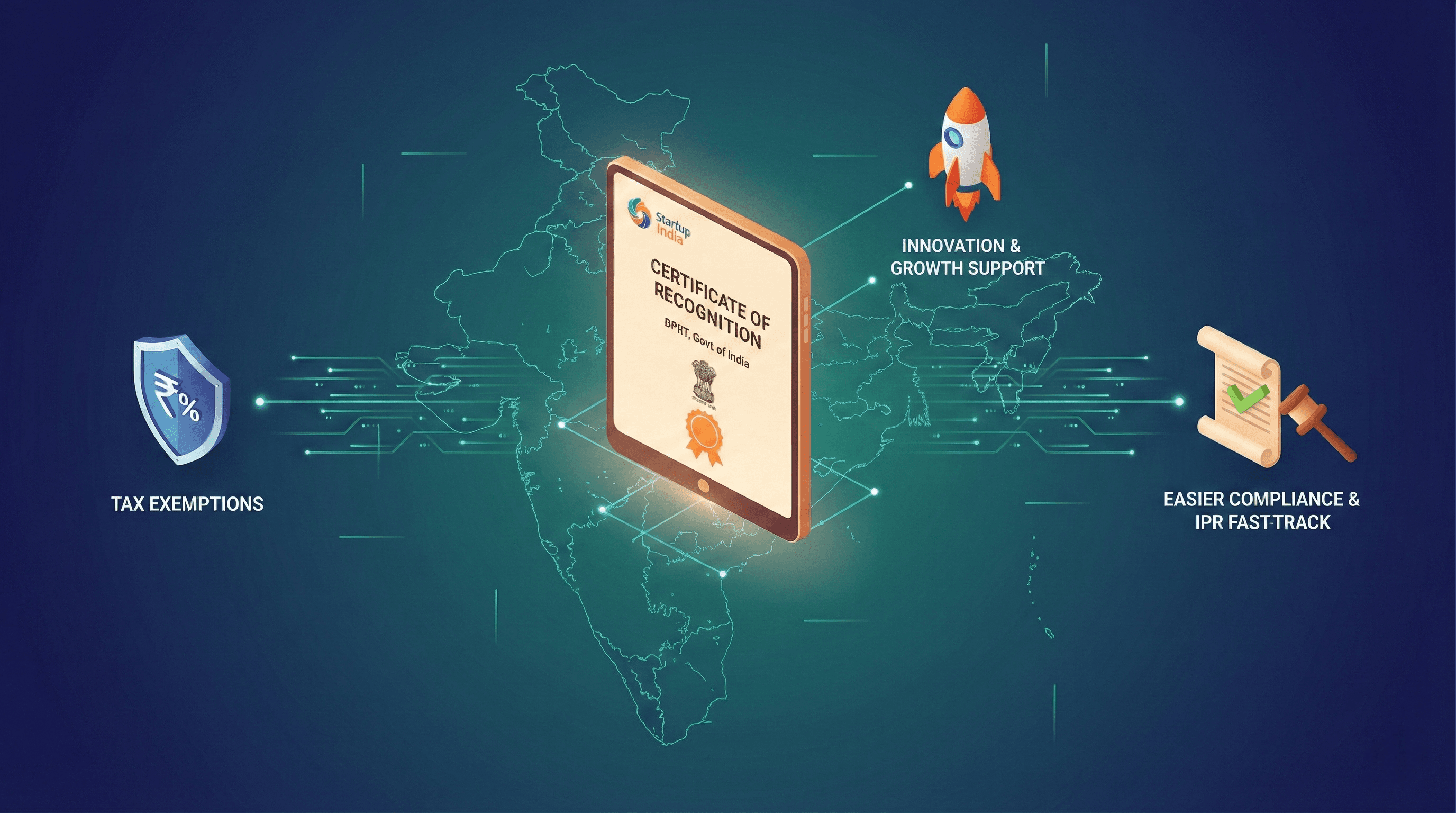
DPIIT recognition under Startup India unlocks tax exemptions, IPR benefits, and easier compliance for innovative businesses. This guide covers eligibility criteria, the free NSWS registration process, Section 80IAC tax benefits, angel tax exemption, and common rejection reasons.
What You'll Learn
- How to unlock 3-year tax exemption (Section 80IAC) and angel tax exemption with DPIIT recognition
- What innovation criteria qualify you beyond just entity type and age
- How to complete the free NSWS registration and which applications unlock tax benefits
Startup India registration via NSWS is 100% free. Never pay consultants or third-party websites for this simple process.
What is Startup India?
Startup India is a flagship initiative launched by the Government of India on January 16, 2016, aimed at building a strong ecosystem for nurturing innovation and startups in the country. The scheme is administered by the Department for Promotion of Industry and Internal Trade (DPIIT) under the Ministry of Commerce and Industry.
DPIIT Recognition vs Being a "Startup"
There's an important distinction many entrepreneurs miss:
| Aspect | General Startup | DPIIT-Recognized Startup |
|---|---|---|
| Status | Self-declared | Government-certified |
| Benefits | None from government | Tax exemptions, IPR benefits, compliance relaxation |
| Credibility | Varies | Official recognition number |
| Funding Access | Limited | Access to Fund of Funds, angel networks |
| Government Tenders | Standard process | Relaxed norms, prior experience waived |
Bottom line: Calling yourself a "startup" doesn't give you any benefits. DPIIT recognition is what unlocks the real advantages.
As of January 2026, over 1,76,000 startups have been recognized under this scheme, contributing to India's position as the 3rd largest startup ecosystem globally.
Eligibility Criteria
Not every business qualifies as a "startup" under DPIIT norms. Here are the specific requirements:
Basic Requirements
| Criteria | Requirement |
|---|---|
| Entity Type | Private Limited Company, LLP, or Registered Partnership Firm |
| Age | Less than 10 years from incorporation |
| Turnover | Less than ₹100 crores in any previous financial year |
| Innovation | Working towards innovation, development, or improvement |
| Original Entity | Not formed by splitting or reconstruction of existing business |
The Innovation Requirement
This is where many applications get rejected. DPIIT expects your startup to be:
- Working towards innovation - Creating new products, services, or processes
- Improving existing products/services - Significantly better than what exists
- Scalable business model - Potential for high growth
- Employment or wealth generation - Contributing to the economy
What qualifies as innovative?
- A new technology solution
- A significantly improved process
- A novel business model
- Products/services that don't exist in the Indian market
What does NOT qualify?
- Trading businesses (buy and sell without value addition)
- Franchise operations of existing brands
- Consulting firms without proprietary methodology
- Real estate development or construction
Simply starting a business doesn't make you a "startup" under DPIIT norms. You must demonstrate innovation or significant improvement in your products, services, or processes.
Who Should Apply?
Ideal Candidates:
- Tech Startups - Building software, apps, SaaS products
- Product Companies - Creating innovative physical or digital products
- Deep Tech Ventures - Working on AI, ML, IoT, blockchain, biotech
- Agritech/Healthtech - Technology-driven solutions in these sectors
When to Apply:
- Immediately after incorporation if you have a clear innovative product/service
- After MVP development if you need to demonstrate proof of concept
- Before raising funding to unlock angel tax exemption benefits
Documents Required
Before starting your application, keep these ready:
For All Entity Types:
- Certificate of Incorporation/Registration
- PAN Card of the entity
- Proof of concept (website, app, product demo)
- Brief description of your innovation (500-1000 words)
Additional for Companies:
- Memorandum of Association (MOA)
- Articles of Association (AOA)
Additional for LLPs:
- LLP Agreement
Additional for Partnership Firms:
- Registered Partnership Deed
Step-by-Step Registration Process
The registration process is entirely online through the National Single Window System (NSWS). Here's how to complete it:
Step 1: Visit NSWS Portal
Go to https://www.nsws.gov.in
This is the official government portal. Do NOT use any third-party websites.
Step 2: Create an Account
If you're a new user:
- Click Register on the homepage
- Select Investor/Business User
- Enter your details (name, email, mobile)
- Verify your email and mobile via OTP
- Complete registration
If already registered, simply login with your credentials.
Step 3: Search for Startup Registration
- From the dashboard, click Know Your Approvals
- Search for Registration as a Startup or DPIIT Startup Recognition
- Click on the service to view details
- Click Apply to start the application
Step 4: Fill the Application Form
The application has several sections:
Under Entity Information, provide your legal name, CIN/LLPIN/Registration number, date of incorporation, PAN number, registered address, and website/app link if you have one.
Under Director/Partner Details, list names of all directors/partners, their DIN/DPIN numbers, and contact details.
The Innovation Description section is the most important. Write a compelling description (500-1000 words) covering what problem you're solving, how your solution is innovative, what makes it different from existing solutions, your business model, and your potential for scalability.
Pro tip: Be specific about your innovation. Generic descriptions like "we use technology to solve problems" will likely get rejected.
Step 5: Upload Documents
Upload scanned copies of your Certificate of Incorporation, PAN Card of entity, proof of concept (screenshots, demo video link, product images), any patents/trademarks/copyrights if applicable, and optionally a pitch deck.
Document specifications: Use PDF or JPEG format, maximum 5 MB per document, and ensure quality is clear and legible.
Step 6: Submit and Track
Review all information carefully, check the declaration box, click Submit, and you'll receive an acknowledgement number.
Typical processing time is 2-5 working days. Track your application by logging into NSWS portal and entering your acknowledgement number.
Step 7: Receive Recognition Certificate
Once approved, you'll receive an email notification. Login to NSWS portal, download your DPIIT Recognition Certificate, which contains your unique Startup Recognition Number.
Keep this certificate safe—you'll need it to claim benefits and apply for tax exemptions.
Benefits of DPIIT Recognition
Once you receive DPIIT recognition, you unlock several valuable benefits:
1. Tax Benefits Under Section 80IAC
DPIIT-recognized startups can apply for 3-year income tax exemption under Section 80IAC.
Key details:
- Exemption: 100% of profits for 3 consecutive years
- Window: Can be claimed in any 3 years out of first 10 years from incorporation
- Eligibility: Annual turnover should not exceed ₹100 crores
DPIIT recognition alone does NOT give you tax exemption. You must separately apply for 80IAC certification through the Inter-Ministerial Board (IMB) after getting DPIIT recognition.
2. Angel Tax Exemption (Section 56)
One of the most valuable benefits for startups raising funding.
What is Angel Tax? When a startup receives investment at a valuation higher than its "fair market value," the excess amount was previously taxed as income.
The exemption: DPIIT-recognized startups are exempt from this provision, meaning:
- You can raise funds at any valuation
- No tax on premium received over fair market value
- Applies to investments from resident investors
How to claim: File Form 2 with DPIIT after securing DPIIT recognition.
3. IPR Benefits
| Benefit | Details |
|---|---|
| Patent Filing Rebate | 80% rebate on patent filing fees |
| Trademark Rebate | 50% rebate on trademark filing fees |
| Fast-track Processing | Expedited examination of patent applications |
| Facilitators | Access to IP facilitators for guidance |
4. Self-Certification for Compliance
Reduced compliance burden under 6 labour laws and 3 environmental laws:
- Self-certify compliance through Startup India portal
- No inspections for 5 years from incorporation (only complaint-based)
- Significantly reduced paperwork and compliance costs
5. Easy Public Procurement
Government tenders become more accessible:
- Prior experience waived: Startups can bid without prior experience requirements
- Earnest money relaxation: Reduced EMD requirements
- GeM registration: Easier registration on Government e-Marketplace
6. Additional Support
- Access to ₹10,000 crore Fund of Funds managed by SIDBI
- Access to Startup India Hub for mentorship
- Invitations to Startup India events and conclaves
- Visibility on Startup India portal
You can (and should) apply for BOTH Startup India and Udyam Registration if eligible. They provide different benefits and maximize your access to government schemes.
Common Mistakes to Avoid
Mistake 1: Weak Innovation Description
Problem: Generic descriptions that don't clearly explain what's innovative.
Fix: Be specific. Instead of "We use technology to improve healthcare," write "We've developed an AI-powered diagnostic tool that can detect diabetic retinopathy from smartphone photos with 95% accuracy."
Mistake 2: Wrong Entity Type
Problem: Applying as a proprietorship or public limited company.
Fix: Only Private Limited Companies, LLPs, and Registered Partnership Firms are eligible. Convert your entity type before applying if needed.
Mistake 3: Thinking Recognition = Tax Exemption
Problem: Assuming DPIIT recognition automatically gives you tax benefits.
Fix: Understand that DPIIT recognition is step 1. For 80IAC tax exemption, you need a separate application to the Inter-Ministerial Board.
Mistake 4: Paying Third Parties
Problem: Paying consultants ₹5,000-₹15,000 for a free registration.
Fix: The process is simple and free. Do it yourself in 20 minutes.
Frequently Asked Questions
QHow long does DPIIT recognition take?
Typically 2-5 working days after submission. Complex applications may take longer.
QIs there any fee for Startup India registration?
No. Registration is completely free. Do not pay any third party.
QCan an existing company apply?
Yes, as long as it's less than 10 years old from incorporation and meets other eligibility criteria.
QWhat if my application is rejected?
You'll receive reasons via email. You can address the concerns and reapply. There's no limit on reapplications.
QCan I apply for both Startup India and Udyam?
Yes, and you should! They provide different benefits. Startup India focuses on innovation-based benefits, while Udyam provides MSME benefits.
QDo I need a working product to apply?
Not necessarily. You can apply at the ideation stage, but you need to demonstrate a clear plan for innovation and proof of concept.
QCan a startup lose its recognition?
Yes, if turnover exceeds ₹100 crores, the entity crosses 10 years from incorporation, or if found providing false information.
Related Articles
Building your startup? Here are some helpful resources:
- What is Udyam Registration? Complete Guide for MSMEs - Apply for both Startup India and Udyam to maximize benefits
- Government Tenders for MSME: How to Win Contracts - Use your DPIIT recognition to access public procurement
Need help with Startup India registration? The official helpline is available at startupindia.gov.in.