

Quick Summary
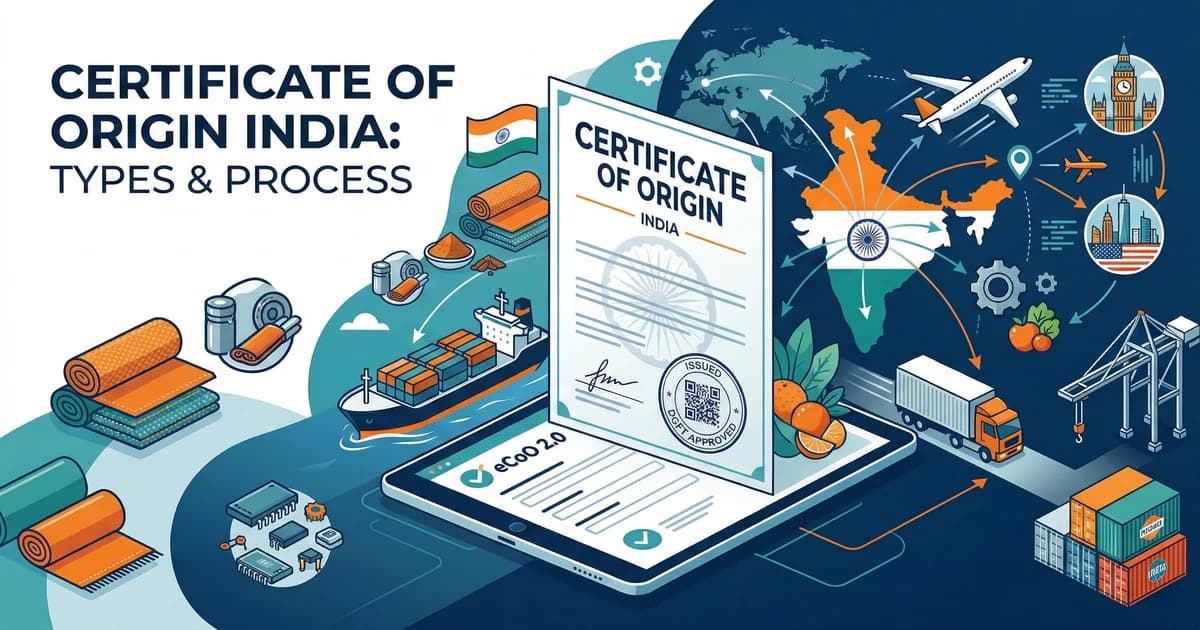
A Certificate of Origin (CoO) is the document that proves where your goods were made, and it directly determines the customs duties your buyer pays. Indian exporters can obtain two types: preferential (for reduced or zero duties under FTAs) and non-preferential (for general compliance). This guide covers both types, India's FTA-wise requirements, the mandatory eCoO 2.0 digital application process, rules of origin criteria, and common mistakes that lead to rejections.
What You'll Learn
- What the two types of Certificate of Origin are and when each applies to your exports
- How to apply through India's mandatory eCoO 2.0 platform at trade.gov.in
- Which Indian FTAs unlock preferential tariff benefits and what origin rules you must meet
Before applying for a Certificate of Origin, check if your destination country has an FTA with India. A preferential CoO can reduce your buyer's import duties from 10-20% down to zero, making your quote significantly more competitive.
What is a Certificate of Origin?
A Certificate of Origin (CoO) is an official trade document that certifies the country where goods were manufactured, produced, or processed. Think of it as a passport for your products. Customs authorities in the importing country use this document to verify where the goods came from and apply the correct import duties.
For Indian exporters, the Certificate of Origin India process serves three key purposes:
- Duty determination helps the buyer's customs calculate the correct import duties based on the source country
- FTA benefits enable your buyer to claim reduced or zero tariffs under Free Trade Agreements
- Trade compliance satisfies import regulations, anti-dumping measures, and quota requirements
The Directorate General of Foreign Trade (DGFT) manages India's CoO issuance through a centralized digital platform that processes over 7,000 certificates daily across 125+ authorized agencies.
Types of Certificate of Origin
India issues two distinct types of Certificates of Origin. Choosing the right one directly affects your buyer's landed cost.
Preferential Certificate of Origin
Issued under specific Free Trade Agreements (FTAs) or Preferential Trade Agreements (PTAs) between India and partner countries. This certificate proves that your goods meet the agreement's rules of origin criteria and qualifies them for reduced or zero customs duties at the destination.
Non-Preferential Certificate of Origin
Certifies that goods originated in India without granting any tariff concessions. Used for general customs clearance, regulatory compliance, anti-dumping verification, and statistical purposes. Goods are subject to standard Most Favoured Nation (MFN) duty rates.
| Feature | Preferential CoO | Non-Preferential CoO |
|---|---|---|
| Purpose | Claim reduced/zero duties under FTA | Regulatory compliance, statistics |
| Tariff Benefit | Yes | No |
| Origin Rules | Strict FTA-specific criteria | General origin rules |
| Issuing Authority | DGFT, EIC, designated agencies | Chambers of Commerce, FIEO, CII |
| Common Forms | Agreement-specific (e.g., India-UAE CEPA form) | Standard CoO format |
A Surat-based textile manufacturer exports cotton shirts (HS Code 6205) worth ₹50 lakh to the UAE. Without a preferential CoO, the buyer pays the standard MFN duty of 5%. With a preferential CoO under the India-UAE CEPA, the duty drops to 0%. That saves the buyer roughly ₹2.5 lakh per shipment, making the Indian exporter's quote more competitive against suppliers from non-FTA countries.
India's FTAs and Certificate of Origin Requirements
India has active trade agreements with multiple countries and blocs. Each agreement has its own CoO form and rules of origin criteria.
| Agreement | Partner | CoO Available on eCoO 2.0 |
|---|---|---|
| India-UAE CEPA | UAE | Yes (since May 2022) |
| India-Australia ECTA | Australia | Yes (since Dec 2022) |
| India-ASEAN FTA | ASEAN (10 countries) | Yes |
| SAFTA | South Asia (8 countries) | Yes |
| India-Korea CEPA | South Korea | Yes |
| India-Japan CEPA | Japan | Yes |
| India-Mauritius CECPA | Mauritius | Yes |
| India-Thailand EHS | Thailand | Yes |
| India-Mercosur PTA | Brazil, Argentina, Uruguay, Paraguay | Yes |
How to Apply for a Certificate of Origin
Since January 2025 (specifically Jan 1 for non-preferential and Jan 17 for preferential), all Certificate of Origin applications must be filed electronically through the eCoO 2.0 platform. Manual certificates are no longer accepted.
Step 1: Register on the eCoO 2.0 Platform
Go to trade.gov.in and register using your Import Export Code (IEC). The platform supports multi-user access under a single IEC, so multiple team members can file applications. First-time users need to create an exporter profile with their business details.
Step 2: Prepare Your Documents
- Valid Import Export Code (IEC)
- HS codes for your products
- Commercial invoice with buyer details and FOB value
- Packing list with weights and dimensions
- Bill of Lading or Airway Bill
- Supplier/manufacturer declaration (for preferential CoO)
- Cost sheet with value addition details (for preferential CoO)
For preferential certificates, you also need to demonstrate that your goods meet the specific FTA's rules of origin. This typically requires a cost sheet showing the domestic value addition.
Step 3: Fill the Application and Select CoO Type
Log into the platform, select whether you need a preferential or non-preferential certificate, and choose the relevant trade agreement (for preferential). Fill in the export details including product HS codes, FOB value, consignee information, and shipment specifics.
Cross-check every field against your commercial invoice and packing list. Mismatches are the most common reason for rejection.
Step 4: Sign, Pay, and Receive Your Certificate
Sign the application using either a digital signature token or Aadhaar-based e-signing. Pay the applicable fee online. For non-preferential certificates, the government fee is typically ₹200 + 18% GST, though authorized agencies may have additional service charges. Preferential certificate fees vary by agreement. Once approved, download your digitally signed certificate with a QR code for verification.
Processing is typically same-day for straightforward applications.
Use Aadhaar-based e-signing if you don't have a digital signature token. It's faster to set up and accepted across all CoO types on the eCoO 2.0 platform.
Authorized Issuing Agencies
Different agencies handle different types of certificates.
For Preferential Certificates:
- DGFT and its regional offices
- Export Inspection Council (EIC)
- MPEDA (Marine Products Export Development Authority)
- Textile Committee (for textile exports)
For Non-Preferential Certificates:
- FIEO (Federation of Indian Export Organisations)
- CII (Confederation of Indian Industry)
- PHD Chamber of Commerce
- Indian Chamber of Commerce (ICC)
- DGFT regional offices
All 125+ authorized agencies are integrated into the eCoO 2.0 platform. Your application is automatically routed to the appropriate agency based on your product category and the agreement you select.
Rules of Origin: What Qualifies?
To get a preferential Certificate of Origin, your goods must meet the relevant FTA's rules of origin criteria. These rules prevent third-country goods from being re-routed through India to claim duty benefits.
Wholly Obtained (WO) applies to goods entirely produced in India using only domestic materials, such as agricultural produce, minerals, and products derived from them.
Change in Tariff Classification (CTC) means the final product has a different HS code than the imported raw materials used. This proves substantial transformation happened in India.
Regional Value Content (RVC) requires a minimum percentage of the product's value (typically 35-40%) to originate domestically. The formula is (FOB value - non-originating materials) / FOB value x 100.
Product-Specific Rules (PSR) apply when certain products have unique origin criteria defined in the FTA's annexures. Always check the specific agreement for your HS code.
Not meeting the rules of origin criteria is the primary reason importing countries reject preferential duty claims. Before applying for a preferential CoO, verify your product's value addition meets the specific FTA threshold. If it falls short, your buyer will be charged the full MFN duty rate, potentially with penalties.
Common Mistakes to Avoid
Applying for the wrong CoO type. Confirm with your buyer whether they need a preferential or non-preferential certificate. Applying for a non-preferential CoO when a preferential one is available means your buyer misses out on duty savings.
Document mismatch. Product descriptions, quantities, and values must match exactly across your CoO, commercial invoice, and packing list. Even minor discrepancies trigger customs scrutiny and delays.
Using the legacy portal. The old coo.dgft.gov.in platform has been deprecated for new applications. All filings must go through eCoO 2.0 at trade.gov.in. Certificates issued through outdated channels may be rejected by partner countries.
Not retaining records. Under CAROTAR 2020, importers must retain all origin-related documentation for at least 5 years. As the exporter, your buyer may request supporting documents during this period. Keep cost sheets, supplier declarations, and production records organized.
India's customs authorities actively verify preferential Certificates of Origin. If your buyer cannot provide supporting origin documentation when requested, their preferential duty claim will be denied and they may face differential duty recovery with interest. This damages your credibility as a supplier.
Frequently Asked Questions
QIs a Certificate of Origin mandatory for all exports?
No. A CoO is required only when the importing country's customs regulations demand it or when your buyer wants to claim preferential tariff benefits under an FTA. For many destinations, it is optional unless specifically requested.
QHow long is a Certificate of Origin valid?
A CoO is typically valid for 12 months from the date of issuance. Some trade agreements specify shorter validity periods, so check the specific FTA terms.
QWhat is the fee for obtaining a Certificate of Origin?
For non-preferential certificates, the standard government fee is ₹200 plus 18% GST. Authorized agencies may charge additional service fees. Preferential certificate fees vary by agreement. Payment is made online through the eCoO 2.0 platform.
QCan one Certificate of Origin cover multiple shipments?
Most FTAs require individual certificates per shipment. Some agreements allow blanket certificates covering multiple shipments of identical goods over 6-12 months. Check the specific trade agreement for provisions.
QWhere can I get help with the eCoO 2.0 platform?
Contact the DGFT helpdesk at 1800-572-1550 (toll-free) or email coo-dgft@gov.in. The platform also provides user manuals for registration and application processes.
Related Articles
Exporting from India? These resources will help:
- Digital Trade Documentation in India: Policy vs Reality - Understand how India's digital trade ecosystem is evolving and why eCoO 2.0 matters
- China Plus One India: Export Opportunity for MSMEs - Leverage preferential CoOs under India's FTAs to compete for global buyers diversifying from China
Certificate of Origin requirements and FTA terms are subject to revision. Always verify current rules on the official DGFT portal and confirm specific FTA provisions before applying.