

Quick Summary
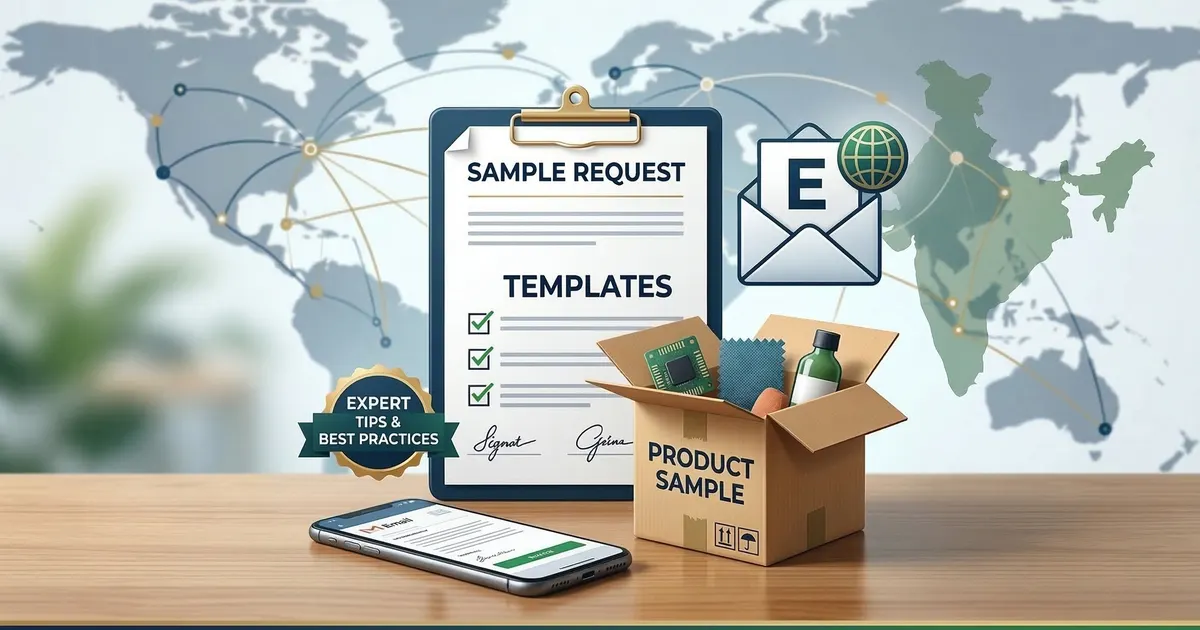
Requesting product samples is the first step to verify quality before placing bulk orders. This guide covers why samples matter, how to request samples from supplier professionally with ready-to-use email templates, India's customs duty exemption (up to Rs. 3,00,000/year), sample costs, and tips for finding and evaluating suppliers on B2B platforms.
What You'll Learn
- How to write professional sample request emails with 3 ready-to-use templates
- What India customs rules allow (Rs. 3L duty-free annual limit under CBIC Notification 29/2024)
- How to avoid costly mistakes like wrong certifications, payment risks, and hidden charges
Why Request Product Samples?
Before committing thousands of rupees to a bulk order, samples give you three critical advantages:
1. Verify Product Quality
Photos can be misleading. Some suppliers use stock images or digitally enhanced pictures. A physical sample lets you assess material quality, finishing, dimensions, and overall workmanship.
2. Test Supplier Reliability
How a supplier handles your sample request reveals a lot:
- Do they respond promptly and professionally?
- Do they ship on time with proper packaging?
- Do they follow your specifications accurately?
This is your test run before a larger commitment.
3. Check Compliance for Indian Market
For products sold in India, you need certifications like BIS, FSSAI, or CDSCO depending on the category. Testing samples helps verify if the product meets Indian regulatory standards before you invest in bulk inventory.
Always order samples from 2-3 suppliers for comparison. Never commit to one supplier based solely on price or photos.
How to Request Samples from Supplier
Before drafting your email, gather these details:
Product Specifications
Be as specific as possible:
- Product name and model number
- Exact dimensions, weight, color (use Pantone codes if applicable)
- Material specifications
- Any customization requirements
- Quantity of samples needed (typically 1-3 units)
Shipping Information
- Complete delivery address with pincode
- Contact person name and phone number
- Preferred courier (DHL, FedEx, or UPS for international)
- Expected delivery timeline
Business Context
- Brief introduction of your company
- Your intended market and use case
- Projected order volume (if sample meets requirements)
Certifications Needed
For importing to India, specify upfront:
- Electronics: BIS certification under CRS scheme
- Food products: FSSAI license requirements
- Pharmaceuticals/cosmetics: CDSCO approval
- Textiles: Azo-free dyes certificate (if applicable)
Mention your projected order quantity in the request. Suppliers prioritize serious buyers who indicate bulk purchase potential.
Email Template 1: General Sample Request
Use this for first-time inquiries to a new supplier:
Subject: Sample Request for [Product Name] - [Your Company Name]
Dear [Supplier Name/Team],
My name is [Your Name] from [Company Name], a [business type, e.g., textile importer/electronics retailer] based in [City, India]. We are exploring suppliers for [product category] to serve the Indian market.
I came across your [product name/model number] and would like to request samples to evaluate quality and suitability for our requirements.
Product Specifications:
- Product: [Exact name/model]
- Quantity: [Number of samples]
- Color/Size/Variant: [Specify]
- Any customization: [If applicable]
Certifications Required:
- [BIS/FSSAI/Other as applicable for Indian market]
Shipping Details: [Your complete address] Contact: [Phone with country code]
We are planning to place an order of approximately [quantity] units if the sample meets our quality standards. Please share:
- Sample cost and payment method
- Shipping charges to India
- Expected delivery time
- Whether sample cost is refundable against first order
Looking forward to your response.
Best regards, [Your Name] [Designation] [Company Name] [Email] | [Phone] [Website if applicable]
Email Template 2: Custom Product Sample Request
Use this when requesting samples with specific modifications:
Subject: Custom Sample Request with Specifications - [Product Name]
Dear [Supplier Name],
I hope this email finds you well. We are [Company Name], an Indian [business type] interested in sourcing [product category] with specific customizations for our brand.
Custom Requirements:
- Base Product: [Model/SKU]
- Modifications Needed:
- [Change 1, e.g., Material: Cotton blend instead of polyester]
- [Change 2, e.g., Logo placement: Embroidered on left chest]
- [Change 3, e.g., Packaging: Custom boxes with our branding]
Technical Specifications: [Attach detailed tech pack, drawings, or reference images if available]
Before we proceed with tooling or customization costs, we would like to request:
- Confirmation that these modifications are feasible
- Pre-production sample timeline
- Cost breakdown: sample unit cost + customization setup + shipping
- Whether setup costs are adjusted against bulk order
Certifications: Please confirm the product will meet [BIS/FSSAI/relevant standard] for India.
Shipping Address: [Complete address with pincode]
Our initial order volume would be [quantity] units, with potential for ongoing orders if quality and pricing align.
Thank you for your time. Please let me know if you need any clarifications.
Warm regards, [Your Name] [Contact Details]
Email Template 3: Follow-Up Request
Use this if a supplier hasn't responded within 3-5 business days:
Subject: Following Up: Sample Request for [Product Name]
Hi [Supplier Name],
I wanted to follow up on my sample request sent on [date]. I understand you may be handling multiple inquiries, but I wanted to ensure my email didn't get missed.
To recap, we are interested in:
- Product: [Name/Model]
- Sample quantity: [Number]
- Estimated bulk order: [Quantity] units
Could you please confirm:
- Whether you can provide samples
- Estimated cost and delivery time to India
We are currently evaluating multiple suppliers and would appreciate your prompt response to keep you in consideration.
Thank you.
Best regards, [Your Name] [Company & Contact Info]
If a supplier refuses to send samples, makes excuses, or pressures you to place a bulk order without samples, walk away. Legitimate suppliers understand samples are standard practice.
India Customs Rules for Importing Samples
Understanding customs regulations helps you avoid unexpected duty charges.
Duty-Free Sample Import Rules
Under CBIC Notification No. 29/2024-Customs (effective July 24, 2024), bona fide trade samples supplied free of charge are exempt from customs duty if they meet these conditions:
| Condition | Limit |
|---|---|
| Individual sample value | Up to Rs. 5,000 per unit |
| Engineering prototypes | Up to Rs. 10,000 per unit (if rendered commercially unusable) |
| Aggregate annual value | Up to Rs. 3,00,000 per year |
| Maximum units per year | 50 units |
Key Points:
- Value is assessed at the goods' worth in the country of dispatch
- Samples must be marked "Sample - Not for Sale" or rendered unusable
- Applies to samples supplied free of charge by the supplier
- Does not apply to items prohibited under Foreign Trade (Development and Regulation) Act, 1992
If Sample Value Exceeds Limits
For samples exceeding Rs. 10,000:
- Pay applicable customs duty upfront, OR
- Submit an undertaking to re-export within 9 months
Ask your supplier to declare the sample value accurately but reasonably on the commercial invoice to help you qualify for duty exemption. Typical practice: declare at production cost, not retail price.
Sample Costs and Payment
How Much Do Samples Cost?
Suppliers typically charge 2x to 5x the unit price for samples. This premium covers:
- Individual production setup (not part of mass production line)
- Packaging for single units
- Administrative handling
Typical ranges:
- Simple products (stationery, basic textiles): $10-50 per sample
- Electronics, machinery parts: $100-500 per sample
- Custom tooling samples (molds, prototypes): $500-3,000
Shipping Costs to India
Express courier (DHL, FedEx, UPS) charges:
- Small parcels (under 1 kg): $50-100
- Medium parcels (1-5 kg): $100-200
- Larger/heavier samples: $200-500+
Safe Payment Methods
| Method | Pros | Cons | Recommended For |
|---|---|---|---|
| PayPal | Buyer protection, dispute resolution, easy | 5-8% total cost (cross-border + forex fees) | Orders under $1,500 |
| Platform Escrow | Buyer protection, refund guarantee | Only available on platforms that offer it | Any B2B marketplace with escrow |
| Wire Transfer (SWIFT) | Standard for larger amounts | No buyer protection, higher fees (₹1,000-2,000) | Orders above $1,500 with verified suppliers |
| Credit Card | Chargeback protection | Not always accepted | When available |
Never pay via Western Union, MoneyGram, or direct bank transfer to personal accounts. These methods offer zero buyer protection and are commonly used in scams.
Where to Find Suppliers for Samples
You can discover suppliers through several channels:
- B2B marketplaces with built-in messaging and buyer protection features
- Trade directories maintained by export promotion councils (EPCs) and industry bodies
- Industry trade fairs like India International Trade Fair, AAHAR, and sector-specific exhibitions
- Government portals like the Indian Trade Portal and DGFT export directories
When using any online platform, verify supplier credentials before ordering samples. Check their business registration, buyer reviews, transaction history, and response rate. Platforms offering escrow or buyer protection add an extra layer of security for sample payments.
For domestic sourcing, sample costs are usually lower since there's no international shipping. Request a GST invoice for every sample purchase and consider arranging a factory visit before committing to bulk orders. If you're a small business, make sure your Udyam Registration is active before engaging with suppliers on government portals.
Browse Tradoi Verified Indian suppliers on Tradoi.com, where a business cannot list until it passes verification and order confirmations are on record.
Common Mistakes to Avoid
Mistake 1: Vague Specifications
Wrong: "Send me a sample of your T-shirt."
Right: "Please send one sample of Style #TS-101, Size L, Navy Blue (Pantone 19-4052), 100% cotton, with your standard packaging."
Mistake 2: Not Ordering from Multiple Suppliers
Relying on one supplier's sample creates no benchmark. Order from 2-3 suppliers to compare quality, pricing, and communication.
Mistake 3: Ignoring Certifications
Don't wait until after receiving samples to ask about BIS, FSSAI, or other certifications. Verify compliance early to avoid wasted sample costs.
Mistake 4: Accepting "Free Samples" Blindly
"Free sample" often means:
- Free product, but you pay shipping (which may be inflated)
- Free first sample, but minimum order commitment
- Free low-quality sample, different from bulk production
Always clarify what "free" means.
Mistake 5: No Written Agreement
Even for samples, get written confirmation on:
- Sample specifications
- Cost breakdown
- Delivery timeline
- Refund policy against bulk order
An Indian electronics importer requested samples of mobile chargers from a supplier claiming BIS certification. After receiving samples, they discovered the supplier only had certification for a different model. This delayed their launch by 3 months. Always verify certification numbers match the exact product variant you're sampling.
What to Check When Samples Arrive
Once your samples reach India, inspect systematically:
Physical Inspection:
- Dimensions and weight match specifications
- Material quality as described
- Finishing, stitching, or assembly quality
- Packaging condition
Functional Testing:
- Does it work as intended?
- Durability under normal use conditions
- Safety compliance (especially for electronics)
Documentation Check:
- Test reports included (if requested)
- Certification copies (BIS, FSSAI, etc.)
- Product specifications sheet
- Care/usage instructions
Supplier Evaluation:
- Did they deliver on time?
- Was communication clear?
- Did the sample match what was promised?
If the sample fails on any critical parameter, provide detailed feedback to the supplier and request a revised sample. Don't proceed to bulk orders hoping "it will improve."
Frequently Asked Questions
Can I request free samples from all suppliers?
Most B2B suppliers charge for samples. Free samples are rare and usually only offered for very low-cost items or by suppliers seeking long-term partnerships. Be cautious of suppliers offering everything free—it may indicate dropshipping or unreliable quality.
How long does it take to receive international samples in India?
- Express courier (DHL/FedEx): 5-10 business days
- Standard air shipping: 10-15 business days
- Sea freight: Not used for samples (too slow)
Factor in 2-3 days for customs clearance if value exceeds duty-free threshold.
Should I sign an NDA before requesting samples?
For custom products with proprietary designs, yes. For standard off-the-shelf products, not necessary. If you're sharing unique designs, technical drawings, or trade secrets, have the supplier sign an NDA (Non-Disclosure Agreement) before sending specifications.
What if the supplier asks for a deposit for a "custom sample"?
This is normal for samples requiring custom molds, tooling, or significant setup. However:
- Verify the supplier's legitimacy first
- Request a formal quotation breaking down costs
- Use escrow or platform buyer protection for security
- Clarify if tooling cost is adjusted against bulk order
Related Resources
- BIS Certification for Products: Complete Guide
- What is Udyam Registration? Complete Guide for MSMEs
- CBIC Notification 29/2024: Duty-Free Sample Imports (Gazette PDF)
- Import of Samples: Legal Provisions (TaxGuru)
Sourcing within India? Tradoi.com, our parent company, lists only Tradoi Verified Indian sellers, so you spend less time sample-testing suppliers who were never real.