

The India UAE CEPA benefits most visible to a small exporter come down to one thing. Your UAE buyer stops paying 5% customs duty on a large share of Indian goods, and your quote becomes cheaper than a competitor from outside the agreement. But the benefit is not automatic. You have to meet an origin rule and carry the right certificate.
This guide covers what the agreement gives you, which products are left out, and the exact steps to claim the duty cut.
What You'll Learn
- The UAE removes duty on 97% of its tariff lines, covering 99% of Indian exports by value
- Your product must pass a 40% value-content test and a tariff-heading change test to qualify
- Indian exporters claim the benefit with a preferential CoO issued through DGFT, not the UAE Ministry of Economy
- Check your 8-digit HS code against the schedule first, because some product groups are excluded
What is the India-UAE CEPA?
The Comprehensive Economic Partnership Agreement (CEPA) between India and the UAE entered into force on 1 May 2022, according to the UAE Ministry of Economy. The PIB describes it as India's first such accord in the Middle East and North Africa region.
A CEPA goes further than a plain FTA. It covers services, investment, government procurement and regulatory cooperation along with goods, as the official FAQ on the CEPA explains. For a manufacturer, though, the goods chapter is where the money is.
How big has the impact been?
Bilateral trade crossed USD 100 billion in FY 2024-25, according to the PIB trade partnerships brochure. India's non-oil exports to the UAE reached USD 27.4 billion in FY 2023-24, growing at an average 25.6% since the agreement began.
The same brochure names electrical machinery, boilers and generators, and organic and inorganic chemicals as major gainers. Smartphones alone shipped USD 2.57 billion to the UAE in FY 2023-24.
These are government figures for the whole economy. They tell you the channel works, not that your product will sell.
Tariff benefits in numbers
Before the CEPA, about USD 26 billion of Indian products faced a 5% UAE import duty. The agreement removes that duty on most of them, and the official FAQ gives the breakdown across the UAE's 7,581 tariff lines.
| UAE tariff treatment | Share of lines | Timeline |
|---|---|---|
| Immediate elimination | 80.3% | From 1 May 2022 |
| Phased elimination (1,089 lines) | 14.4% | Zero duty in 5 years |
| Phased elimination (180 lines) | 2.4% | Zero duty in 10 years |
| Phased reduction (35 lines) | 0.5% | Up to 50% cut |
| Exclusion list (187 lines) | 2.4% | No concession |
Overall, 90% of India's exports to the UAE by value became duty free on day one. The immediate zero-duty list covers gems and jewellery, textiles, leather, footwear, sports goods, plastics, furniture, engineering goods, pharmaceuticals, medical devices and automobiles.
The UAE offered no tariff-rate quotas on any of its lines. So there is no cap on how much of a qualifying product you can ship at zero duty.
A Ludhiana garment maker ships readymade shirts worth ₹40 lakh to a Dubai importer. At the old 5% rate, the buyer paid roughly ₹2 lakh in duty. Under the CEPA with a valid preferential CoO, that cost is zero. The exporter can either hold the price and give the buyer a better margin, or cut the quote and beat a supplier from outside the agreement.
The origin rule that decides everything
Your goods get the zero duty only if they count as originating in India. The FAQ describes two routes.
- Wholly obtained. The product is produced entirely in India, which is how many agricultural products are treated.
- Product-specific rule. The most common version needs two things together. The good must have at least 40% qualifying value content, with FOB value as the base. And every non-originating material must have undergone a change in tariff classification at the four or six-digit HS level.
Gems and jewellery have a lower value-addition requirement because processing adds only 3 to 7% to the value. Steel products carry a stricter melt-and-pour condition.
Here is what trips people up. Buying an input from an Indian trader does not make it Indian in origin. If that fabric, component or chemical was imported, it counts as non-originating, and you must account for it. Keep the value and HS code of every non-originating input on file, since the FAQ lists this as the minimum information an exporter must hold.
The agreement blocks third-country goods from using the concession. If you are a trader who simply relabels or repacks imported goods, you will not pass the substantial processing test, and your buyer's preference claim will not hold up if origin is checked.
How to claim the benefit as an Indian exporter
The steps below follow the DGFT process for exports to the UAE. Use the HS code article linked in the checklist if you are unsure of your code.
- Find your 8-digit HS code. Our guide on how to find the HS code for your product walks through this.
- Look up the UAE tariff treatment. The UAE Ministry of Economy CEPA page carries the full agreement text and a market access dashboard for checking preferential rates by HS code.
- Test your product against the origin rule. List every input, mark which are imported, and compute your value content on the FOB price.
- Hold an IEC with updated details and a Class III digital signature, both required under the DGFT notice. If you do not have the code yet, read how to get an IEC.
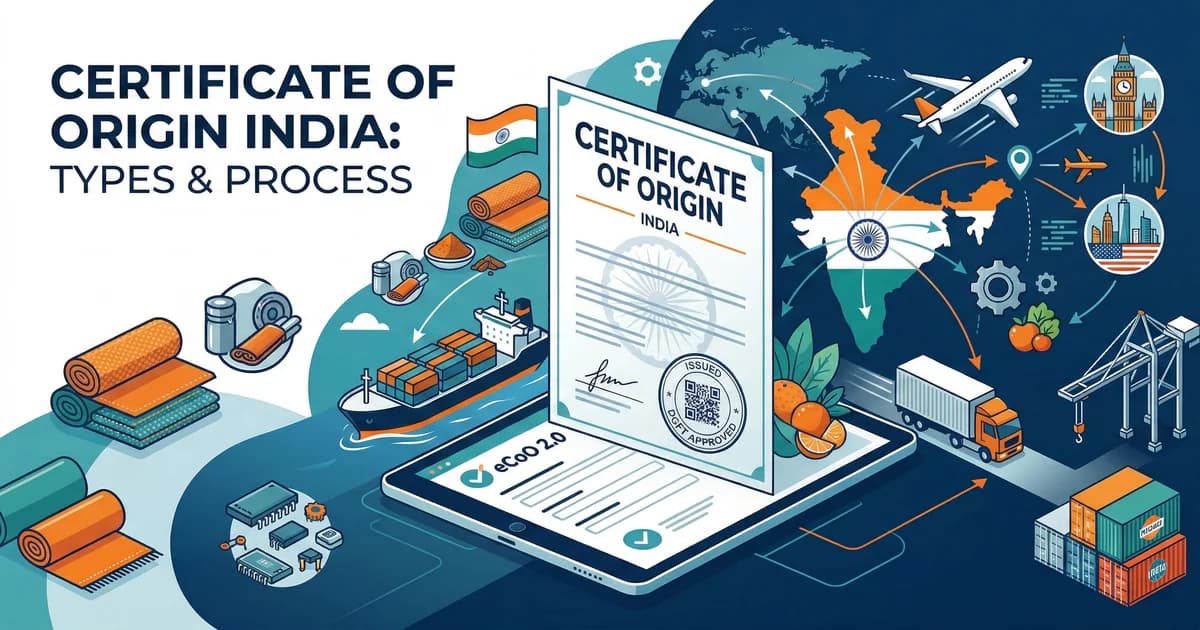
- Apply for the preferential CoO online through DGFT's eCoO platform. DGFT's Trade Notice 05/2022-23 moved UAE-bound preferential certificates onto the electronic platform from 1 May 2022 (it named coo.dgft.gov.in). DGFT's current Handbook of Procedure says authorised agencies must issue CoOs only through trade.gov.in or another platform DGFT designates, so apply there and check the DGFT site if the portal has moved again. Only agencies notified in Appendix 2B can issue the certificate.
- Attach the certificate to your shipping set. Each eCoO carries a QR code, and DGFT's notice says the certificate number can also be verified online.
For a full walk-through of CoO types and agencies, see our guide to the Certificate of Origin in India.
Do the origin calculation before you quote, not after the order is booked. If your value content lands near 40%, a small change in input prices can push you under the line mid-contract.
Products that are not covered
Exporters get caught here. The UAE keeps 187 lines (2.4%) in its exclusion list, so confirm your HS code is not one of them before you pass the saving on to a buyer.
On the Indian import side, which matters if you source from the UAE, 1,157 products (9.72%) are excluded. The official FAQ lists jewellery (except a 2.5 tonne gold jewellery quota), dairy, fruits and nuts, cereals, tea, coffee and spices, sugar, tobacco, footwear, toys, plastics, medical devices and most automobiles and components. Gold carries a quota of 200 tonnes over 5 years at 1% duty reduction.
The agreement also contains a permanent safeguard mechanism. A party can suspend further tariff cuts or restore the duty if a sudden import surge seriously injures a domestic industry.
Special benefits for pharma exporters
The CEPA has a separate pharmaceuticals annex, described in the FAQ as a first in any trade agreement. Products approved by the US FDA, UK MHRA, EMA or Japan's PMDA are eligible for automatic registration and marketing authorisation in 90 days, per the official FAQ. If you make generics, that is a faster route into the UAE than a standard registration.
Mistakes that cost exporters the benefit
- Skipping the origin test because the product is Made in India. The label does not decide origin.
- Not keeping input records. If the buyer's customs asks for proof, you need your input values and HS codes ready.
- Quoting zero duty before checking the exclusion list.
- Assuming a GST benefit comes with it. Exports are zero-rated for GST separately, so read GST on exports and how to file an LUT to avoid blocking your own working capital.
- Missing paperwork. Our export documents checklist covers the full set a UAE shipment needs.
What to do next
Pick your top three export products, find each 8-digit HS code, and check the UAE schedule for treatment. Then run the origin test on each. Do this before your next buyer call so you can quote the duty advantage with confidence.
The agreement is a real cost advantage for exporters who prepare for it. For those who skip the origin work, it is just a headline.